


White Papers · Performance Consulting
Training request · question 1
A request has arrived with the solution already in the sentence.
The solution request
Why a competent, sincere, well-informed request is a hypothesis rather than a diagnosis, and the four questions that test one without insulting the person who made it.
No. 12 · © 2026 Tulser
In this paper
Nobody calls the fire department to report a shortage of water.
The question
A request has arrived naming a solution, from somebody who is close to the work and probably right about the symptom. How do you test it before spending, without treating a colleague as a suspect, and what do you do when the test says no?
For
L&D and HR business partners who receive requests, and the managers who make them. Also useful to anyone in OD, quality or communications who is asked for a solution by name.
Read
24 minutes · with a worked case and a one-page instrument.
| 01 | “We have a water problem” | The form every request arrives in, and why it is not carelessness. |
| 02 | Everyone diagnoses in their own vocabulary | Including us, which is why the test has to be a method rather than a character. |
| 03 | Demanding the result, choosing against it | The performance paradox, the four pressures that feed it, and what it costs twice. |
| 04 | No number, no case | Five real requests, and what is missing from every one of them. |
| 05 | Four questions that test a request | Twenty minutes, asked in the first conversation, in this order. |
| 06 | Three endings, and only one of them is “no” | What happens after the test, and why refusing is the rarest outcome. |
| 07 | The onboarding that was never the problem | A worked case in which the request was accurate and the remedy was not. |
| 08 | What this does not claim | Four limits, because the rest is not credible without them. |
| · | Run it yourself | Six lines, on the request in front of you. |
Tulser · White Papers · Performance Consulting
The solution is in the sentence.
The problem is not.
Tulser · White Papers · Performance Consulting
01 · The habit
“We have a water problem”
When a building is burning, nobody telephones the fire department to report a shortage of water. The problem is the fire. Whether water is the right answer depends on what is burning, and in a chemical plant it is emphatically not.
The second example is closer to home and slightly funnier. “We have a pesticide problem.” No: there are unwanted insects. Pesticide is one candidate answer. A screen on the window is another, and it costs less, works faster and does not have to be repeated every spring.
Both examples are Jim Fuller’s, from the book he wrote with Jeanne Farrington on the move from training to performance improvement (Fuller & Farrington, 1999). They have been in this profession’s teaching for a quarter of a century and they still land, which is itself a finding about how little the habit has shifted.
Requests inside organizations arrive in exactly this form. Not “sales per visit have fallen eleven percent since March”, but “we need customer-experience training”. Not “three of the last nine handoffs went wrong”, but “the team needs to communicate better”. The solution is in the sentence and the problem is not. Whoever accepts the sentence as written has committed to a fix before anybody established what it was fixing.
Dana and James Robinson named this conversation and the role that has to hold it. Their point was that a request of this form is one of only two ways work reaches a practitioner, the other being a business result that is already moving, and that the whole craft consists of getting from the first to the second (Robinson & Robinson, 1995). Number 02 places them in the lineage.
This is not carelessness, and treating it as carelessness is the fastest way to lose the conversation. It is how competent people behave under time pressure. A manager who has watched a problem for six weeks has formed a theory, and the theory arrives dressed as a request because that is the only form the organization reliably accepts. Ask for an analysis and you get a raised eyebrow. Ask for a course and you get a budget code.
The distinction that saves the case
A request is a hypothesis, not a diagnosis. It is worth taking seriously precisely because the person making it is close to the work, and worth testing for exactly the same reason. Close observers see the symptom first and most vividly, and vividness is not evidence about cause.
Tulser · White Papers · Performance Consulting
02 · The mirror
Everyone diagnoses in their own vocabulary
Roughly a tenth of an iceberg sits above the water. Managers and advisors alike work from what they can see there, and what they can see is shaped by what they already know how to do.
The pattern is uncomfortable because it is so regular. A coach walks into a struggling team and perceives a coaching problem. An interim manager perceives a structural one. A process consultant sees a process. A learning specialist sees a skills gap. Each is sincere, each is experienced, and each has diagnosed the case in the vocabulary of their own toolkit.
Harless put the mechanism plainly forty years ago, and included his own profession in it: what gets rewarded is the last event in the chain, which is choosing a solution, so the role predicts the remedy, and the consultant’s most probable solution is whatever the consultant is selling at the time (Harless, 1985, p. 4).
Which includes the person reading this
An advisor who profits from the requested solution is being asked to mark their own homework. That is not an accusation; it is a structural fact about the position, and it applies to us as much as to anybody. The answer to it is a method rather than a character reference: questions asked in a fixed order, evidence the organization already holds, and a written test that a third party could apply to the same case and reach the same place.
The practical correction is a rule about evidence rather than a rule about skepticism. Perception is a hypothesis until it has been tested against something the organization already counts. Below the waterline sit the numbers (output, rework, cycle time, complaints, absence, retention) and they do not care what anybody sells.
Tulser · White Papers · Performance Consulting
“
Reinforcers get attached to the last event — which is solution-selection. Analysis almost never gets rewarded.
Joe Harless
Performance + Instruction, 1985, p. 4
Tulser · White Papers · Performance Consulting
03 · The paradox
Demanding the result, choosing against it
There is a specific trap underneath almost every request of this kind, and it has a name in this practice: the performance paradox. A manager demands a better result and chooses an intervention that cannot reach the cause of the shortfall, and then expects the result anyway.
Stated that plainly it sounds like carelessness, and it is not. It is what happens when four ordinary pressures meet in one person, and each of the four is reasonable on its own.
| What feeds it | How it is experienced from inside |
|---|---|
| The pressure to improve | The number is watched, the quarter is running, and doing nothing visible is not an available option. |
| The training reflex our term, from Kostbaar misverstand | Faced with a problem or an opportunity, the organization reaches for a course, because that is the move it has a route for. |
| The diploma chase | Certificates are countable, auditable and defensible, so the qualification becomes the objective and displaces the result it was meant to serve. |
| Thinking in solutions | The mind arrives at a remedy before it has finished with the problem, and the remedy then becomes the thing being discussed. |
Four pressures, one outcome. Note that none of them is a failure of intelligence,
and that all four push in the same direction.
[practitioner observation, not a measured frequency]
What the paradox costs is worth spelling out, because it is not only the money. The time and the fees are spent. The manager who commissioned it becomes the person who commissioned it. Skepticism about training hardens on the floor, and the next proposal, which may be entirely sound, meets a room that has been here before. A sense of déjà vu sets in that makes the good case harder to win than the bad one was.
Tulser · White Papers · Performance Consulting
03 · continued
Why the requester cannot do this for you
The obvious objection is that the manager knows their own operation far better than any advisor ever will. That is true, and it does not produce the conclusion it seems to.
There is a durable finding in psychology that people have limited access to the processes behind their own judgements, and that when asked to explain them they report plausible reasons rather than the operative ones (Nisbett & Wilson, 1977). Number 07 uses the same finding for a different purpose: it is why an exemplary performer cannot simply tell you what makes them exemplary. Here it cuts in the other direction. Somebody who has watched a problem daily for six weeks has an account of its cause that feels like observation and is partly construction.
Put the two together and the position is clear. The person best placed to notice the problem is not thereby well placed to diagnose it, and the closer they are, the more confident and the more coherent the account will be. Confidence is a property of the narrator, not evidence about the cause, and the four pressures above are all pushing the same account towards the same remedy.
How to say this out loud without insulting anybody
Not: “your diagnosis may be wrong.” Say instead what is actually true and rather flattering: “you have seen this longer than anybody. What I want to do is check your reading against what the systems already record, so that whatever we buy is defensible when somebody asks in six months.” Nobody refuses that, because it offers them protection rather than doubt, and it is honest, because it is exactly what the test does.
One further point about who tests. This is the reason a request should never be tested only by the function that would deliver the solution. Not because that function is untrustworthy, but because the same limitation applies to it, in the same way, about its own reasoning, and because it is subject to the second of the four pressures more than anybody.
Tulser · White Papers · Performance Consulting
04 · The missing number
No number, no case
Before any solution can move a business result, three elements have to be on the table: a gap stated as the distance between current and desired performance, evidence that the gap matters to the organization, and a cause established below the symptom. Most requests satisfy none of the three, and still sound entirely reasonable.
| What arrives | What the requester says causes it | What is asked for |
|---|---|---|
| The team barely talks to each other; an informal circuit has taken over | Too little feedback; people feel undervalued; no shared view of teamwork. | A three-session training in communication and team development. |
| This unit is not customer-focused; complaints are rising | Staff take too little ownership; complaints are read as insults. | A four-session customer-friendliness training. |
| Our culture is not results-driven; agreements are not agreements | Low engagement; management steers too little. | An off-site on shared values, kept enjoyable. |
| Workload is so high we need a burnout-prevention program | Workload, turnover, absence | A two-session stress-prevention training: could it be e-learning? |
| Project work is a disaster; deadlines are never met | No ownership in the project group; leaders do not steer on deadlines. | A project-management program using our own projects. |
Five requests of the kind that arrive weekly. Each names a symptom, a set of
impressions and a remedy, and not one of them contains a number (after Arets & Heijnen, 2008).
Read the middle column again. Every entry is plausible and every entry is untested. “People feel undervalued” may be true and still be a consequence rather than a cause. Absence and turnover in the fourth row are not causes of workload; they are what high workload leaves behind.
Tulser · White Papers · Performance Consulting
04 · continued
What a number actually does
The absence of a number is not a formality. It changes what kind of object the request is, and therefore what can ever be said about it afterwards.
“Repeat orders are at 62 percent and the business needs 75” is a case. You can tell whether it is worth solving, you can tell where the shortfall sits, and afterwards you can tell whether you solved it. “They need to be more customer-focused” is a wish, and a wish cannot be evaluated, which is precisely why programs built on wishes are never quite finished and never quite fail.
The most useful thing to notice about that
An unevaluable request is comfortable for everybody in the room, including the person who delivers it. That comfort is the reason the habit survives, and it is worth naming rather than moralizing about. Asking for a number is asking somebody to accept the possibility of failing visibly, which is a real thing to ask and should be asked in that spirit.
Where no number exists, the emptiness is itself the first finding: the same finding number 05 reaches from the other door. A result nobody counts is a result nobody is accountable for, and that is worth reporting before any discussion of remedies. It is also, frequently, the cheapest thing this whole method ever produces.
Tulser · White Papers · Performance Consulting
05 · The test
Four questions that test a request
Twenty minutes, in the first conversation, before any commitment. The order matters: each question is answerable, none of them is hostile, and together they establish whether there is a case at all.
| Ask | Why it is not a hostile question | What a blank means |
|---|---|---|
| 1 · Which number is disappointing, and by how much? | You are asking what they care about, which is the most respectful question in the set. | No measure. The first finding, and the analysis has already earned its keep before it started. |
| 2 · Since when, and what changed then? | It invites their expertise: they were there and you were not. | Nobody noticed the onset, which usually means the measure is not watched: a second finding, at a different level. |
| 3 · Is everybody short, or some people? | A factual question about a distribution, with no implied blame. | The cut has not been made. It takes an afternoon and it decides which of the six conditions can even be candidates. |
| 4 · Does anybody here already achieve it? | It is the optimistic question, and people enjoy answering it. | Nobody does, which is itself important: a desired level nobody has ever reached is a different problem from one that some people reach daily. |
Four questions, and the blanks are worth more than the answers. Each blank is a
finding you can report before spending anything.
Note what is not in the list. There is no question about whether the requested solution is a good one, and no question that requires the requester to defend their reasoning. The four questions are about the work, not about the request, which is why they can be asked by somebody junior, of somebody senior, without the conversation turning.
And the sentence that opens the door
“Before I quote you for this, can I take half a day to check it against what the systems already record?” Half a day is small enough to grant without a decision, it sounds like diligence rather than obstruction, and it is usually enough to establish which of the four blanks you are dealing with.
Tulser · White Papers · Performance Consulting
06 · The endings
Three endings, and only one of them is “no”
The fear that stops this method being used is that testing a request means refusing it. In practice refusal is the rarest of the three outcomes, and the least useful one to lead with.
| The ending | What it looks like | How often, in our practice |
|---|---|---|
| Confirmed, and now sharper | The cause really is knowledge and skill. The analysis has narrowed it to which people, which task and which part of the task, so the program is shorter, aimed and evaluable. | Common. And note that the requester gets a better version of what they asked for, at lower cost. |
| Confirmed in part | Skill is one of two or three binding conditions. The program goes ahead alongside a change to a report, a rule or a queue, and the analysis says what share each is expected to move. | The most common ending, and the one that most needs the other conditions to have an owner in the room. |
| Not this | The cause is somewhere the program cannot reach. What replaces it is not “no” but a finding with an address: this condition, at this level, owned by this person. | Less common than the profession fears, and it is the ending that changes an L&D function’s standing when it survives contact with the manager. |
Three endings. Two of them buy training, and all three buy it better.
[practitioner observation, not a measured frequency]
Which is the argument to make internally, and it is not the one usually made. Testing requests is not a way of saying no more often. It is a way of making the yes defensible, and of ensuring that when the answer really is a program, it is aimed at something, sized against something, and provable afterwards against the standard in number 11.
Tulser · White Papers · Performance Consulting
The request was accurate.
The remedy was somebody else’s job.
Tulser · White Papers · Performance Consulting
07 · A worked case
The onboarding that was never the problem
A logistics operator, 900 warehouse staff, heavy seasonal hiring. The request: an extended onboarding program, because new starters were making too many picking errors in their first months. Delivered at the rates the operator already paid, that is a substantial program.
The request was accurate about the symptom, and the requester, a site manager with eleven years there, was right about almost everything. Four questions, one afternoon.
| Question | Answer |
|---|---|
| Which number, and by how much? | Picking accuracy. Desired 99.5 percent; the site ran at 98.6. Fourteen errors per thousand lines against five. |
| Since when? | Fourteen months, stepping down rather than drifting, which is the pattern of a change, not of a decay. |
| Everybody or some people? | New starters were worse: 97.9 against 99.0 for staff with more than a year. The requester was right. |
| Does anybody achieve it? | Yes. Two of the eleven aisles ran at 99.6 with the same mix of new and experienced staff. |
The third answer confirmed the request. The fourth undid it, because if new
starters can reach 99.6 in two aisles, being new is not what makes them inaccurate.
What differed about those two aisles was label placement. They had been relabeled during a refit fourteen months earlier, the same fourteen months, and carried the item code at eye height on the bay rather than at ankle height on the shelf lip. Everywhere else, a picker confirming a code had to crouch.
Tulser · White Papers · Performance Consulting
07 · continued
Why the new starters really were worse
The most instructive part of this case is that the requester’s observation was correct and their inference from it was not, and the two are easy to confuse in a meeting.
New starters genuinely were less accurate, and not because they knew less about picking. Staff who had worked the aisles for a year had memorized the layout and no longer needed to read the labels at all, so a label that was hard to read cost them nothing. New starters read every one. The condition was identical for both groups; only one group was exposed to it.
That is worth stating as a general pattern, because it recurs. Where experience conceals a condition, the newest people look like the problem. Every remedy aimed at them will be aimed at the wrong thing, and the measure will improve on its own as each cohort learns to work around the obstacle, which reads, a year later, as proof that the onboarding worked.
| Measure | Before | After relabeling, two quarters |
|---|---|---|
| Picking accuracy, whole site | 98.6% | 99.4% |
| New starters | 97.9% | 99.2% |
| Staff over one year | 99.0% | 99.5% |
Still a tenth of a point short of the desired level, and the operator accepted
that. The onboarding program was never built.
The site manager, who had asked for the program, presented the finding to the regional meeting himself. That is the ordinary outcome when a test is run with somebody rather than on them.
Tulser · White Papers · Performance Consulting
08 · The limits
What this does not claim
Testing requests is a professional posture with costs of its own, and the costs fall on the person doing the testing.
- It is not a license to refuse work. A function that tests every request and concludes “not training” every time has replaced one reflex with another, and the second is less forgivable because it claims evidence. Section 06 gives the three endings; refusal is the rarest.
- The requester is usually right about the symptom. This paper argues that a request is a hypothesis, not that it is mistaken. In the case above every observation the site manager made was accurate. What did not follow was the inference.
- The evidence about self-report is imported. That literature examined how people account for their own mental processes, largely in laboratory settings, not how managers explain a delivery number. Applying it here is an inference and is stated as one.
- The fire and the iceberg are illustrations, not evidence. Both have been used in this practice for twenty years and neither carries any weight in the argument. Where an image does the work of a finding in somebody’s report, that report has a problem.
Summary
A request names a solution because that is the only form the organization accepts, and the person making it is close enough to the work to see the symptom clearly and no more. Four questions in the first conversation establish whether there is a case, and the blanks are worth more than the answers. The point of the test is not to say no. It is to make the yes defensible.
Tulser · White Papers · Performance Consulting
Run it yourself
Six lines, on the request in front of you
Twenty minutes, with the requester rather than about them. Lines one to four are the test; five and six decide what you do with it.
1 · Which number is disappointing, and by how much?
Their number, in their words, with the period. A blank here is the finding: write it down as one.
2 · Since when, and what changed then?
A step or a drift? A step has a date and a date has a cause. Ask what else happened that month.
3 · Everybody, or some people?
Ask for the underlying records rather than the report. Uniform, concentrated or two clusters?
4 · Does anybody here already achieve it?
Who, and by how much? If somebody does, the desired level is reachable in this organization and the difference is your finding.
5 · What the requested solution would reach
If the program were delivered perfectly, which of the six conditions would change? Write the sentence out.
6 · The half-day sentence
“Before I quote for this, can I take half a day to check it against what the systems already record?” Send it today, to the person who asked.
Tulser · White Papers · Performance Consulting
Where this paper sits
Two problems, one method, sixteen papers
| Business problem | Training request | |
|---|---|---|
| Owned by | The manager or director who owns the result. | L&D and the HR business partner. |
| What it prevents | Spending on the wrong intervention: a system, a reorganization, a hire. | Spending on a program that cannot reach the cause. |
| What it returns | The fix that moves the number, chosen on evidence. | The budget and the working hours that were not spent. |
| Method used | The same three analyses and five questions, which is why one capability serves both, and why the diagnosis no longer has to be bought in case by case. | |
One method, two returns, and a standing capability instead of a standing
consultancy line.
Two models carry the method. Gilbert’s six conditions ask what kind of cause; Rummler and Brache’s three levels ask where it sits. Both are sound and this series uses both, and it leads with Gilbert, because his unit is the accomplishment, which is what an organization already counts, and because his six conditions are the categories an organization can actually change.
Tulser · White Papers · Performance Consulting
Where this paper sits · continued
Where the method comes from
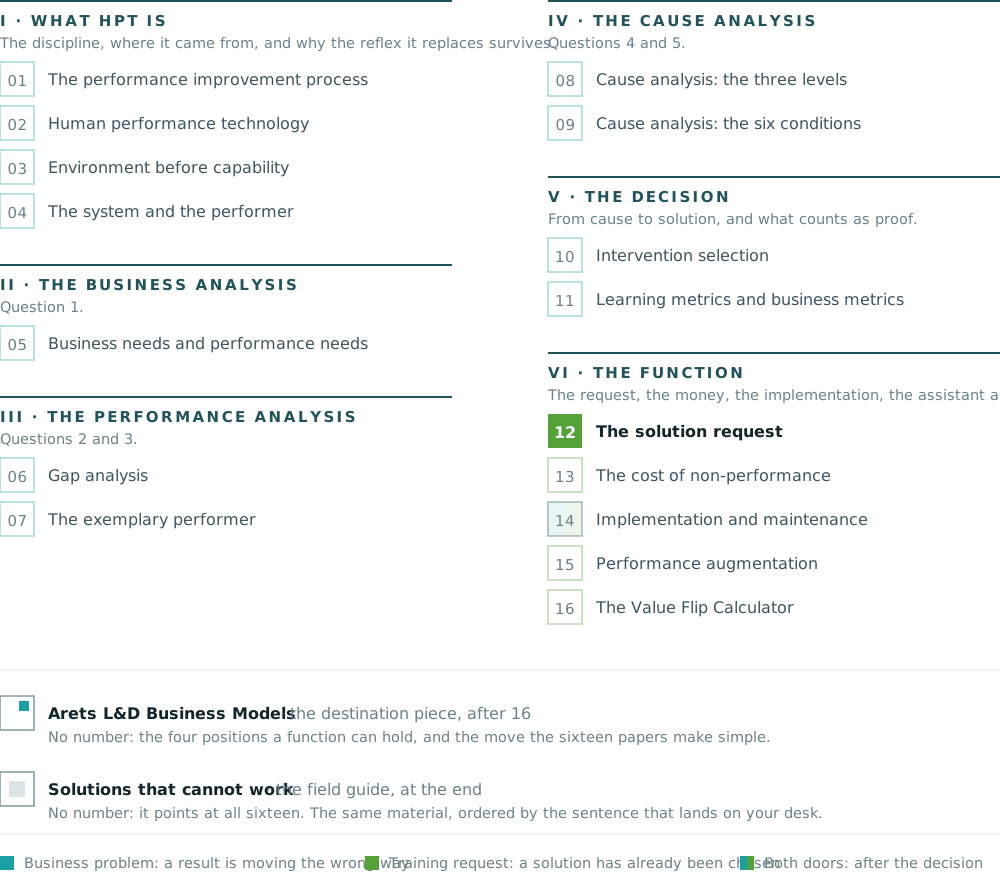
Two further pieces close the set and carry no number, because each points at all the numbered papers. Before the guide sits Arets L&D Business Models, the destination piece for the people who receive the requests: four models a learning function can run, and the route from HR-driven to business-driven. Last sits Solutions that cannot work, the field guide, ordered by the sentence that lands on your desk: seventeen forms a performance problem arrives in, each with an address in one of the numbered papers. Three orders in all: the destination you choose, the question you are on, and the form that landed on your desk.
How this series came about
Human performance technology travels the way a craft does: from hand to hand. Vivian Heijnen and Jos Arets learned the analysis from Dennis Mankin, in San Diego, more than twenty years ago, and have kept in contact with him ever since. Both remain grateful to him: for the rigor of the method as he taught it, and for the leadership he has given performance consulting over a long career.
What followed was twenty years of use. Vivian took the method into organizations in the Netherlands and well beyond them, and what accumulates over that many analyses is largely tacit: the cut nobody thought to make, the question that opens a defensive room, the finding that turns out to be an artifact of the data. Making that knowledge explicit, case by case, is what this series is for. Jos wrote it down as it went, in two books and more than forty articles and blog posts, most of them in Dutch, and one seven-part English series, Is AI the bicycle of the mind?, which number 15 grows out of. The books: Liever (g)een training with Boudewijn Overduin, Kostbaar misverstand with Vivian Heijnen, which this series takes a good deal of its thinking from.
None of that is reprinted here. It has been reworked: brought up to date, tested against the research that has appeared since, and dropped where the evidence no longer carries it. Theory that has never met a client is a position; practice that cannot account for itself is a story. This series is what remains when each is held to the other. Performance Consultant AI carries the same discipline to the desk where the decision is actually made.
About the cases. Every worked case in this series comes from our own practice. Names are changed and details altered so that no organization is recognizable, and the arithmetic reconciles. That is said once, here, rather than under each case: client work is confidential, and a case that named anybody would be a breach rather than a proof.
Tulser · White Papers · Performance Consulting
The series
Sixteen papers, six parts
Number 01 is the map and number 02 is the foundation. From number 05 on, every number is depth on exactly one step of the method. The filled block is the paper you are holding; the two unnumbered pieces close the set.
Tulser · White Papers · Performance Consulting
References
Where every claim in this paper comes from
Arets, J., & Heijnen, V. (2008). Kostbaar misverstand: Van training naar business improvement [A costly misunderstanding: From training to business improvement]. Academic Service.
Fuller, J., & Farrington, J. (1999). From training to performance improvement: Navigating the transition. Jossey-Bass/Pfeiffer.
Harless, J. H. (1985). Invited address: Performance technology and other popular myths. Performance + Instruction, 24(6), 4–6. https://doi.org/10.1002/pfi.4150240603
Robinson, D. G., & Robinson, J. C. (1995). Performance consulting: Moving beyond training. Berrett-Koehler.
Nisbett, R. E., & Wilson, T. D. (1977). Telling more than we can know: Verbal reports on mental processes. Psychological Review, 84(3), 231–259. https://doi.org/10.1037/0033-295X.84.3.231
The other two books named earlier in this paper are listed in full in number 02, so that they do not recur in every reference list. Number 02 also sets out the evidence rule this series follows: empirical claims rest on meta-analyses and systematic reviews, and nothing here is supported by a single study.
Tulser · White Papers · Performance Consulting