


White Papers · Performance Consulting
The map · both doors
Start here, whichever way the work reached you.
The performance improvement process
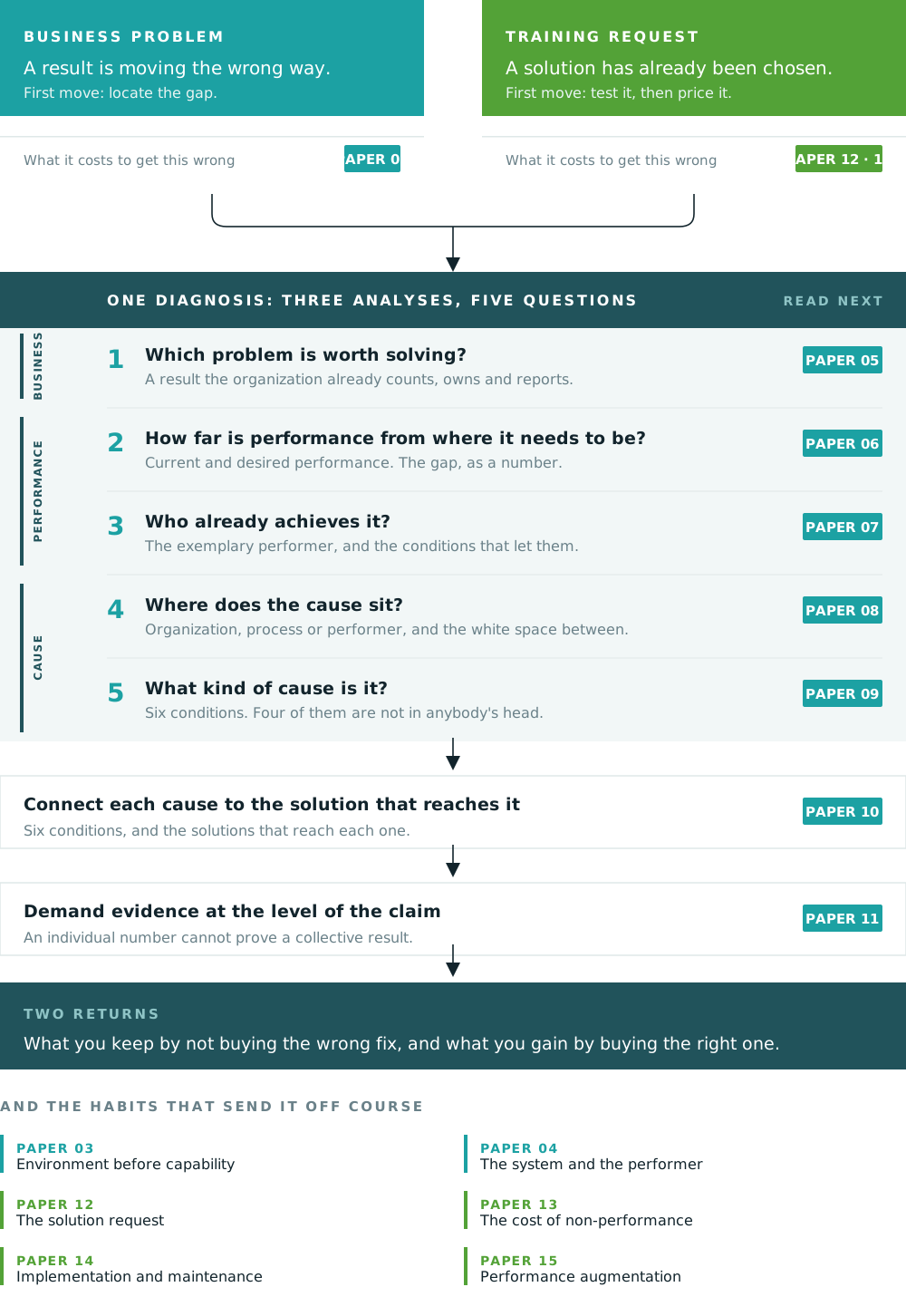
Two doors a performance problem arrives through, four ways a solution fails when nobody establishes the cause, one method for both, and the sixteen papers that go deeper.
No. 01 · © 2026 Tulser
In this paper
The whole method, in twelve minutes.
The question
A result is going the wrong way, or a solution is already on my desk. Where do I start, and what must be established before anyone spends money?
For
Anyone who owns a result (line managers, directors, OD, quality and improvement staff) and anyone asked to fix one, from L&D to the HR business partner.
Read
12 minutes · the map is in section 04, the route to the other papers in section 05.
| 01 | Two doors, and what happens without a diagnosis | Work arrives in two forms, and four ways a solution fails when nobody establishes the cause. |
| 02 | Three analyses, five questions | The workflow, and why the order is not negotiable. |
| 03 | What this is, and what it is not | A discipline with a name, a society and ten standards: in outline. Number 02 takes it in full. |
| 04 | The map | The route from problem to fix, with every paper pinned to the step it deepens. |
| 05 | Six conditions, the route, and one case | The instrument, which paper answers which question, and the five questions run on one problem. |
| 06 | What comes back | A diagnosis with its own confidence, in the language of whoever must act. |
| 07 | Why this was never routine | The method is old. What changed is the cost of running it. |
| 08 | What it cannot do | Four limits, because the rest is not credible without them. |
| · | Start here | Your door, your problem, one diagnosis. |
Tulser · White Papers · Performance Consulting
Nobody buys the wrong solution on purpose.
It simply looked like the right
one.
Tulser · White Papers · Performance Consulting
01 · Two doors
Two doors, one method
Performance problems arrive in two forms. The form decides your first move. It decides nothing after that.
In the first, a result is moving the wrong way. Deliveries are late, defects are up, repeat orders are down, an audit came back badly. No solution has been named. The person who owns that number wants the cause and the fix.
In the second, the solution is already chosen. It arrives as a sentence: we need a training in de-escalation, a leadership program, a culture change. A result is moving the wrong way behind that sentence too, but it has been translated into a solution before anyone established the problem. That translation is the misunderstanding this series exists to take apart, and it is the subject of Kostbaar misverstand (Arets & Heijnen, 2008), which much of the thinking here comes from.
| Business problem | Training request | |
|---|---|---|
| What arrives | A number moving the wrong way. | A solution, already chosen. |
| Who holds it | The manager or director who owns the result. | L&D, or the HR business partner who received the ask. |
| First move | Locate the gap: which result is moving, who reports it, how far off it is. | Test it, then price it: what would have to be true for it to work, and what the decision is worth. |
| The exposure | Buying the intervention that came to mind: a system, a reorganization, a hire. | Buying a program aimed at the one part of the problem that was probably fine. |
| Everything after | Identical. Three analyses, five questions, in the same order. | |
The doors differ in what they protect you from. They do not differ in method.
That last row is the business case for one method rather than two. A director and a learning advisor are protecting the organization from different mistakes. They need the same evidence to act, and once they have it they are looking at the same page.
Tulser · White Papers · Performance Consulting
01 · continued
And what happens when nobody establishes the cause
The case for diagnosis is usually made as savings, which is the weakest version of it. The stronger version is about what an organization can and cannot know afterwards.
Something almost always gets bought. A program, a system, a restructure, a campaign, a new supervisor. What happens next falls into four patterns, and an organization that did not establish the cause beforehand cannot tell which of the four it is in.
| What happens | How it is experienced | Why nobody notices |
|---|---|---|
| Nothing moves | The remedy was aimed at a condition that was not the binding one. The number sits where it was. | Nobody goes back. By the time anyone might, the sponsor has moved and the budget line has closed. |
| Something moves, and it is not the result | Attendance, satisfaction, confidence and completion all improve. The measure the organization runs on does not. | This is reported as success, in good faith, because the measures that improved are the ones the program was tracking. |
| It moves and then comes back | Six good months, then the same problem, usually with a different explanation attached to it. | The return is treated as a new problem. Nobody has the first analysis to compare it with, because there was none. |
| It moves and nobody can say why | The number improves. Three initiatives changed that quarter and the organization cannot tell which one moved it. | Success is not investigated. And so it cannot be repeated at the next site, which is the expensive part. |
Four outcomes of acting without a diagnosis. Only the first looks like failure, and
it is the least costly of the four.
The fourth is the one worth sitting with. An organization that improves a result without knowing why has not learned anything it can use again, and the next region, the next plant, the next department starts from the same place the first one did. Undiagnosed success and undiagnosed failure are the same condition wearing different faces.
Tulser · White Papers · Performance Consulting
02 · The workflow
Three analyses, five questions
The workflow has three phases and five questions. It is not a study, a survey or an audit. Days, not months, and each question narrows the next.
Business analysis: question 1
Which problem is worth solving? A result the organization already counts, owns and reports. Not “engagement is low” but “on-time delivery fell from 96 to 78 percent.” What that costs is a separate question with its own arithmetic, and number 13 does it. Where no such number exists, establishing one is the first output, and it usually explains why the problem has run for two years.
Performance analysis: questions 2 and 3
How far is performance from where it needs to be? Two values on one measure: current performance and desired performance. Desired is not perfection, and it is not a number somebody picked in a meeting. The strongest version of it is a level that people in this organization already reach, which is what the next question establishes. The distance between the two is the gap, and it is what any solution has to close.
Who already achieves it? In almost every organization we have analyzed, somebody gets the result under the same conditions with the same tools. What they do differently, and what they have that others lack, is evidence the organization already owns, and the first place a sound analysis looks.
Cause analysis: questions 4 and 5
Where does the cause sit? At the level of the organization, the process that crosses departments, or the person doing the work. The most expensive causes live in the handoffs: the white space on the organization chart, where work stops between two jobs and nobody owns it (Rummler & Brache, 2013).
What kind of cause is it? Six conditions make performance possible, and four of them sit in the work environment rather than in the person. The condition that is binding decides which solutions can work.
Why the order is not negotiable
Without the result, the gap has no significance. Without the gap, causes cannot be ranked. Without causes, a solution is a preference. Reverse the order and you get what most organizations get: a solution looking for a justification.
Tulser · White Papers · Performance Consulting
03 · The discipline
What this is, and what it is not
This is not a proprietary framework and it is not a learning method. It is a professional discipline with a name, a definition, a certifying body and more than sixty years of published work behind it.
The name is Human Performance Technology. Its society (the International Society for Performance Improvement, founded in 1962) describes it as a systematic approach to improving productivity and competence that “uses a set of methods and procedures, and a strategy for solving problems, for realizing opportunities related to the performance of people” (ISPI, 2004). The society certifies practitioners against ten published standards, and the order of those standards is the method: be about the result, establish the need, establish the cause, and only then design, implement and evaluate.
It was assembled by people working on different problems in different industries and different decades: Harless on analysis before design, Gilbert on the accomplishment rather than the behavior, Deming on results as a property of the system, Rummler on the white space between departments. They converged, and that convergence is the reason to trust the order of the questions rather than any single author. Number 02 takes the discipline, its history, its four traditions and the ten standards in full; this page is here so that you know what kind of thing you are reading about.
Note what the standards do not contain. No solution type is named anywhere in them: not training, not coaching, not a system, not a reorganization. They describe an obligation to find out and an obligation to prove, and they are silent on what the answer will turn out to be, which is the only honest position for a discipline that claims not to know in advance.
What that means for the rest of this paper
Everything after this page is the method rather than the case for it. If you want the case (the sixty years, the evidence, and the strongest published argument against doing any of this) read 02, 03 and 04 before going further. If you have a problem in front of you now, skip them and go to 05.
Tulser · White Papers · Performance Consulting
“
Tell me the job title and I’ll tell you the most probable solution which will be specified.
Joe Harless
Performance + Instruction, 1985, p. 4
Tulser · White Papers · Performance Consulting
04 · The map: two doors, three analyses, two returns
Tulser · White Papers · Performance Consulting
05 · The instrument
Six conditions, and the order to ask them in
The workflow puts the person at the end of the cause analysis rather than the beginning. That ordering is not a courtesy. It is where the measured evidence points, and number 03 is where that evidence is set out.
| Ask in this order | The condition | What its absence looks like |
|---|---|---|
| 1 | Clear expectations and honest feedback. | Capable people drifting, each with a different idea of “good”. |
| 2 | Information, tools, materials and time. | Workarounds, second spreadsheets, steps done twice. |
| 3 | Incentives that point the same way. | The wanted behavior is the punished one. |
| 4 | A process that is not fighting them. | Work stopping between two departments. |
| 5 | Capacity for the work. | The right task in the wrong hands. |
| 6 | Knowledge and skill | People who genuinely do not know how. |
Six conditions, after Gilbert (1978) in the ordering proposed by Chevalier (2003).
Training reaches the sixth. The first five are the ones a course cannot touch. This is the short form;
number 09 carries the full picture of what each condition looks like while it is missing, and who can
arrange it.
The order does the work. Asked in this sequence, each question either finds a cause that is cheaper and faster to fix than the next one, or rules it out and hands the problem on. Asked in reverse, which is how a request usually arrives, the sixth condition absorbs a problem that belonged to one of the first five, and the money is spent before anyone has looked.
Tulser · White Papers · Performance Consulting
05 · continued
Which paper answers which question
This is a map, so here is the route in the form a map should take: your situation, the question you are actually at, and the number to read next. If you have one afternoon and one problem, the shortest useful path is 05, then 06, then 07, which between them produce a measured gap with a defensible target and a list of conditions to examine.
| If this is where you are | You are at | Read |
|---|---|---|
| A result is moving the wrong way and nobody has named a solution | Question 1: is this a business need or a performance need? | 05, then 06. |
| You have a measure but no idea how far off it is, or where the target came from | Question 2: the gap. | 06 |
| Somebody already gets the result and nobody asked how | Question 3: the exemplary performer. | 07 |
| You know the size of the problem and not where it sits | Questions 4 and 5: the cause. | 08, then 09. |
| You have causes and need to choose what to do | The decision | 10, then 11. |
| A solution is already chosen and you must deliver it | The training request | 12, then 13. |
| You need the discipline itself first | The foundation | 02, then 03 and 04. |
Seven entry points, one method. Nothing in this table requires reading the series
in order, and most readers should not.
Tulser · White Papers · Performance Consulting
05 · continued
The five questions, on one problem
A map is not much use without one demonstration. A building-products distributor: three orders in ten arriving outside the five-day promise, and everybody with the same explanation (the warehouse had an ownership problem, and specifically a supervisor with a reputation). Here is that problem taken through all five questions. Number 04 carries it in full.
| The question | What it returned |
|---|---|
| 1 · Which result is moving, and who reports it? | Not “ownership”. Delivery inside the five-day promise, on the operations director’s report, for as long as anyone could remember. |
| 2 · How far off is it, and against what? | Single-zone orders at 4.7 days; two-zone orders at 11.2. The average nobody had split was hiding two unrelated situations. |
| 3 · Who already achieves it? | One branch ran two-zone orders at 5.2 days. A shift lead there walked the second zone’s picks across at eleven and at three, every day, and had never mentioned it. |
| 4 · Where does the cause sit? | Between two picking zones: the white space. Neither zone reported the 2.1 days an order waited there, because the wait belonged to neither of them. |
| 5 · What kind of cause is it? | Information and process. The transfer had no owner, no schedule and no timestamp, so it appeared in no system at all. |
Five questions, five answers, four working days of analysis. Not one of the
answers is about a person.
The fix was a scheduled zone-to-zone transfer twice a shift and a timestamp on the handoff, so that the wait would appear in a system for the first time. The timestamp was a configuration change. The performance conversation did not take place.
What it cost and what it prevented
Four days of somebody’s time, most of it spent splitting a number that already existed. What it prevented was a conversation with a supervisor who turned out to be handling the only queue in the building nobody had timed.
Tulser · White Papers · Performance Consulting
06 · The output
What comes back
Run the three analyses and you do not get an opinion. You get a document with a fixed anatomy, and every part of it can be argued with. That is the point.
| The diagnosis returns | What it contains |
|---|---|
| The gap | The result wanted, the result today, and the measured distance: the number the whole case turns on. |
| The causes | Each one placed at a level, attached to a condition, and labeled with how far the evidence reaches. |
| The moves | What would actually change the result, in sequence, with training among the candidates rather than ahead of them. |
| Still to confirm | The questions that would turn a strong diagnosis into a watertight one. |
| Confidence | One score for how far the evidence carries, and exactly what would raise it. |
The same anatomy whether the problem is a delivery number or a request for
fifty people.
It comes out in more than one voice. The person who owns the money, the manager who owns the team and the analyst who owns the detail do not read the same document. The evidence stays identical; the length and the language change. That is what lets a diagnosis travel from the shop floor to the board without being rewritten by three people on the way.
The subject of the report changes most. Not what was delivered (how many people, how satisfied, how complete) but what was found, what it is costing, and what to do about it.
Tulser · White Papers · Performance Consulting
The method is sixty years old.
What changed is the cost of running it.
Tulser · White Papers · Performance Consulting
07 · What changed
Why this was never routine
If the case is this strong and this old, the obvious question is why almost nobody works this way. The answer is not disagreement. It is price.
Running the workflow properly meant a skilled analyst, several weeks, and access to the person who actually owns the problem. It also meant the standing to question a manager’s own diagnosis: on every request, not on the two or three a year somebody could find time for. Most organizations had neither the analyst nor the weeks. So the request went straight to delivery, and everyone told themselves the analysis would have said the same thing.
Two constraints changed. The administrative weight of an analysis (structuring a conversation, computing what a request costs, classifying causes, writing the same finding four ways) is arithmetic and formatting, and it is now automatic. And the part that was genuinely scarce, the diagnostic reasoning, no longer has to sit in one head in one building. A system that carries the method puts the questions an experienced investigator would ask in front of whoever is holding the problem, in any region, on any day.
Tulser · White Papers · Performance Consulting
08 · The limits
What it cannot do
A method that will not name its own boundaries should not be trusted with a budget. Four limits, stated plainly.
- It cannot invent data that does not exist. Where nobody measures the result the organization is unhappy about, the first output is a short list of the numbers it does not keep.
- It cannot watch the work. Standing beside someone who already gets the result, and noticing the step that appears in no procedure, is human work. The method says whom to watch and what to look for. It cannot look.
- It cannot make anyone accountable. A diagnosis produces results only when the person who owns the problem also owns the solution. Where the causes sit in another director’s process, naming them changes nothing by itself.
- It cannot carry the decision. Every cause is labeled with how far the evidence reaches. Acting on evidence that is good enough, and defending that choice, belongs to a person.
And one thing it is not
None of this is an argument against training. Where the cause genuinely is a shortfall in knowledge or skill, well-designed learning is exactly right and nothing substitutes for it. The point is diagnostic discipline: you cannot know that training is the answer until you have ruled out the five conditions that cost less, move faster and are more often to blame.
Tulser · White Papers · Performance Consulting
Start here
Your door, your problem, one diagnosis
Ten minutes, on the problem in front of you now. Answer these five and you have the input a diagnosis needs. Leave one blank and you have found the first thing to establish.
1 · Which door are you at?
A result moving the wrong way, or a solution already chosen? Write the sentence exactly as it reached you.
2 · The result and who reports it
What is moving, from what to what, and on whose report does the measure appear?
3 · Who already achieves it
Name one person, shift, site or unit getting the result under the same conditions.
4 · Which of the six conditions
Expectations, information and tools, incentives, process, capacity, knowledge, which could produce this number on its own?
5 · The full price of the solution on the table
Direct spend plus travel plus working hours. The third is usually the largest, and number 13 does the arithmetic.
Tulser · White Papers · Performance Consulting
Where this paper sits
Two problems, one method, sixteen papers
| Business problem | Training request | |
|---|---|---|
| Owned by | The manager or director who owns the result. | L&D and the HR business partner. |
| What it prevents | Spending on the wrong intervention: a system, a reorganization, a hire. | Spending on a program that cannot reach the cause. |
| What it returns | The fix that moves the number, chosen on evidence. | The budget and the working hours that were not spent. |
| Method used | The same three analyses and five questions, which is why one capability serves both, and why the diagnosis no longer has to be bought in case by case. | |
One method, two returns, and a standing capability instead of a standing
consultancy line.
Two models carry the method. Gilbert’s six conditions ask what kind of cause; Rummler and Brache’s three levels ask where it sits. Both are sound and this series uses both, and it leads with Gilbert, because his unit is the accomplishment, which is what an organization already counts, and because his six conditions are the categories an organization can actually change.
Tulser · White Papers · Performance Consulting
Where this paper sits · continued
Where the method comes from
Two further pieces close the set and carry no number, because each points at all the numbered papers. Before the guide sits Arets L&D Business Models, the destination piece for the people who receive the requests: four models a learning function can run, and the route from HR-driven to business-driven. Last sits Solutions that cannot work, the field guide, ordered by the sentence that lands on your desk: seventeen forms a performance problem arrives in, each with an address in one of the numbered papers. Three orders in all: the destination you choose, the question you are on, and the form that landed on your desk.
How this series came about
Human performance technology travels the way a craft does: from hand to hand. Vivian Heijnen and Jos Arets learned the analysis from Dennis Mankin, in San Diego, more than twenty years ago, and have kept in contact with him ever since. Both remain grateful to him: for the rigor of the method as he taught it, and for the leadership he has given performance consulting over a long career.
What followed was twenty years of use. Vivian took the method into organizations in the Netherlands and well beyond them, and what accumulates over that many analyses is largely tacit: the cut nobody thought to make, the question that opens a defensive room, the finding that turns out to be an artifact of the data. Making that knowledge explicit, case by case, is what this series is for. Jos wrote it down as it went, in two books and more than forty articles and blog posts, most of them in Dutch, and one seven-part English series, Is AI the bicycle of the mind?, which number 15 grows out of. The books: Liever (g)een training with Boudewijn Overduin, Kostbaar misverstand with Vivian Heijnen, which this series takes a good deal of its thinking from.
None of that is reprinted here. It has been reworked: brought up to date, tested against the research that has appeared since, and dropped where the evidence no longer carries it. Theory that has never met a client is a position; practice that cannot account for itself is a story. This series is what remains when each is held to the other. Performance Consultant AI carries the same discipline to the desk where the decision is actually made.
About the cases. Every worked case in this series comes from our own practice. Names are changed and details altered so that no organization is recognizable, and the arithmetic reconciles. That is said once, here, rather than under each case: client work is confidential, and a case that named anybody would be a breach rather than a proof.
Tulser · White Papers · Performance Consulting
The series
Sixteen papers, six parts
Number 01 is the map and number 02 is the foundation. Every number from 05 is depth on exactly one step of the method, and no number repeats what 01 explains. The filled block is the paper you are holding; the two unnumbered pieces close the set.
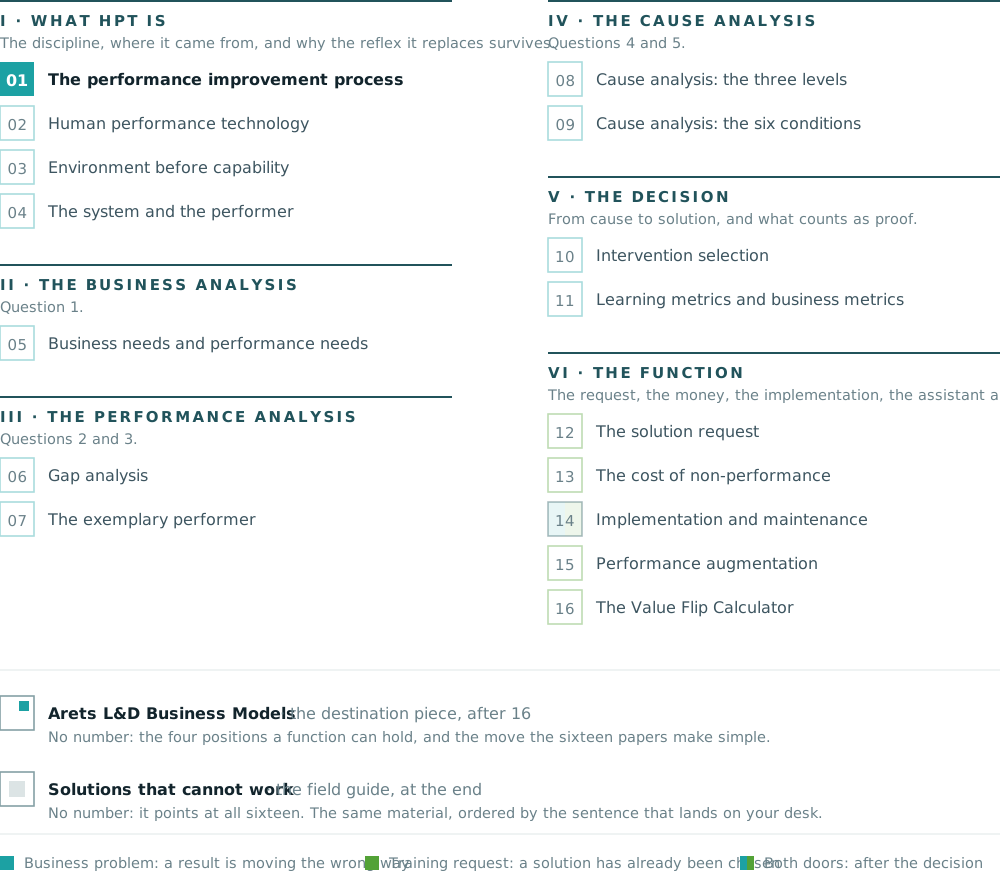
The second way in
Solutions that cannot work, the field guide at the end of the set, is the same material ordered by the sentence that lands on your desk: seventeen forms, each with the number that takes it apart. The last piece in the set, and the first you will open.
Tulser · White Papers · Performance Consulting
References
Where every claim in this paper comes from
This number takes one claim from Kostbaar misverstand (Arets & Heijnen, 2008), never translated, so the book is listed below. Much of the thinking in this series comes from it. The other two books named earlier are listed in full in number 02.
Albarracín, D., Fayaz-Farkhad, B., & Granados Samayoa, J. A. (2024). Determinants of behaviour and their efficacy as targets of behavioural change interventions. Nature Reviews Psychology, 3(6), 377–392. https://doi.org/10.1038/s44159-024-00305-0
Arets, J., & Heijnen, V. (2008). Kostbaar misverstand: Van training naar business improvement [A costly misunderstanding: From training to business improvement]. Academic Service.
Blume, B. D., Ford, J. K., Baldwin, T. T., & Huang, J. L. (2010). Transfer of training: A meta-analytic review. Journal of Management, 36(4), 1065–1105. https://doi.org/10.1177/0149206309352880
Chevalier, R. (2003). Updating the behavior engineering model. Performance Improvement, 42(5), 8–14. https://doi.org/10.1002/pfi.4930420504
Deming, W. E. (2000). Out of the crisis (2nd ed.). The MIT Press. (Original work published 1986)
Gilbert, T. F. (1978). Human competence: Engineering worthy performance. McGraw-Hill. (The passage quoted in this paper is taken from the primary text as reproduced, with its page, in Winter, 2015, p. 29.)
Harless, J. H. (1970). An ounce of analysis is worth a pound of objectives. Harless Performance Guild.
Harless, J. H. (1985). Invited address: Performance technology and other popular myths. Performance + Instruction, 24(6), 4–6. https://doi.org/10.1002/pfi.4150240603
Hughes, A. M., Zajac, S., Woods, A. L., & Salas, E. (2020). The role of work environment in training sustainment: A meta-analysis. Human Factors, 62(1), 166–183. https://doi.org/10.1177/0018720819845988
International Society for Performance Improvement. (2004). About ISPI. In G. A. Rummler, Serious performance consulting according to Rummler (front matter). ISPI & ASTD.
International Society for Performance Improvement. (2013). Certified Performance Technologist: Performance standards (updated 22 February 2013). ISPI. https://cdn.ymaws.com/ispi.org/resource/resmgr/pdfs/cptperformancestandards__1_.pdf
International Society for Performance Improvement. (2026). Performance standards. Retrieved 26 July 2026, from https://www.ispi.international/performance-standards
Kang, S. P., & Molenda, M. H. (2018). How shall we define human performance technology? Performance Improvement Quarterly, 31(2), 189–212. https://doi.org/10.1002/piq.21276
Pershing, J. A. (Ed.). (2006). Handbook of human performance technology (3rd ed.). Pfeiffer.
Rummler, G. A., & Brache, A. P. (2013). Improving performance: How to manage the white space on the organization chart (3rd ed.). Jossey-Bass. (Original work published 1990)
Wallace, G. W. (2023). The L&D pivot point: Performance improvement consulting. Self-published. ISBN 979-8-9862171-5-4
Winter, B. (2015). Agile performance improvement: The new synergy of Agile and human performance technology. Apress.
Tulser · White Papers · Performance Consulting