


White Papers · Performance Consulting
The foundation · both doors
Sixty years of one question, and the answer the field kept arriving at.
Human performance technology
Where the discipline came from, what it commits a practitioner to, and why finding the cause of a performance problem is worth more to an organization than treating what it can see.
No. 02 · © 2026 Tulser
In this paper
A field that started by being wrong.
The question
What is this discipline, where did it come from, what does it require of anyone who claims to practice it, and what does an organization get for working this way rather than the way it works now?
For
Anyone deciding whether to build this capability: directors and boards, HR and L&D leadership, OD, quality and continuous improvement, and practitioners who want the lineage of what they do.
Read
22 minutes · with a timeline, the ten standards in full and a one-page instrument.
| 01 | Sixty years of one question | A society founded to promote instruction, which spent six decades discovering its limits. |
| 02 | Six people: what four broke, and what two settled | Gilbert, Harless, Rummler, Deming, and the two who settled what a need is and whose job it is to ask. |
| 03 | Why it is called a technology | The claim is replicability, and it is a demanding claim. |
| 04 | Ten standards, and the one that gets squeezed | The society’s ten in full, the four obligations they group into, and what each asks you to produce. |
| 05 | What an organization gets for it | Five changes it brings, what the evidence supports, why this field has few studies, and the strongest published case against. |
| 06 | The performance consultant | What the posture is, and why it is a posture rather than a job title. |
| 07 | What this is not | Four limits, because the rest is not credible without them. |
| · | Run it yourself | Does your organization find causes, or treat what it can see? |
Tulser · White Papers · Performance Consulting
A field that began by selling instruction
spent sixty years discovering what instruction cannot reach.
Tulser · White Papers · Performance Consulting
01 · The history
Sixty years of one question
The discipline did not set out to be what it became. It was founded to promote a teaching method, and the whole of its history is the record of that method turning out to be the answer far less often than anybody expected.
In 1962 a group of military and civilian training people in Texas founded a society for programmed instruction and began publishing its journal the same year. Programmed instruction was then the most serious idea in training: sequence the content correctly, test at every step, and learning becomes engineering rather than art.
It worked, within its limits, and the limits arrived quickly. Practitioners kept meeting problems that better instruction did not touch: people who already knew what to do and did not do it, work that failed between two competent departments, incentives that quietly paid for the wrong behavior. By 1973 the society was publishing under a different name, the National Society for Performance and Instruction, conceding, in one added word, that instruction was one intervention among several. In the mid-1990s “instruction” disappeared from the name entirely: the International Society for Performance Improvement.
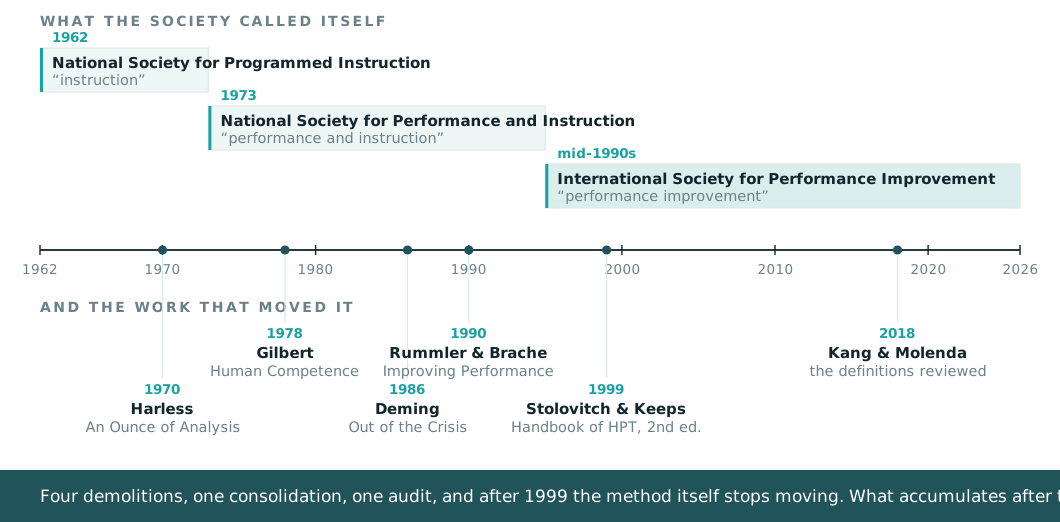
Two renamings, roughly two decades apart, each one an admission. The years are
those under which the society’s own publications appear in library records.
Tulser · White Papers · Performance Consulting
01 · continued
A field that is honest about having been wrong
That sequence is worth dwelling on, because it is rare. A professional body founded to advance a technique publicly abandoned the technique as its organizing idea, twice, and kept the membership.
It is also the reason the discipline can be trusted on this particular question. A field that sells training and concludes that training is rarely the answer is not arguing in its own interest. It arrived there by watching what happened when it kept prescribing the same remedy, and it wrote the disappointment down.
Harless said it most bluntly in 1985, in an article whose whole subject is the myths the profession told itself: “Selling training, or its dumber brother, education, is hucksterism when there is no front-end present” (Harless, 1985, p. 4). He published it in the society’s own journal, about the society’s own practice.
What the renamings actually record
Not a change of technique but a change of unit. In 1962 the unit was the lesson. By the mid-1990s it was the performance, what somebody accomplishes at work, whatever it takes to get there. Everything else in this series follows from that move, including the awkward part: once the unit is the accomplishment, the department that owns the lessons is no longer the department that owns the problem.
The question the field has been asking for sixty years is therefore not “how do we teach this better?” It is: what is actually stopping the work from happening, and is it anything we know how to sell?
Tulser · White Papers · Performance Consulting
02 · The four
Four people and what each of them broke
The discipline was assembled by people working on different problems in different industries. What makes their agreement interesting is that none of them was trying to agree with the others, and each arrived by breaking something the others had left intact.
| Who | What they broke | What was left standing |
|---|---|---|
| Joe Harless An Ounce of Analysis, 1970 | The assumption that a stated objective is a starting point. He put analysis in front of design and called anything else guessing. | The front end: the idea that a diagnosis precedes a prescription, and that skipping it is the expensive move (Harless, 1970). |
| Thomas Gilbert Human Competence, 1978 | The equation of behavior with performance. What matters is not what people do but what they leave behind. | The accomplishment as the unit, the exemplary performer as the benchmark, and six conditions of which only one lives in the person (Gilbert, 1978). |
| W. Edwards Deming Out of the Crisis, 1986 | The attribution of results to the worker. His own estimate settles the argument: “94% belongs to the system (responsibility of management), 6% special”. | Variation as a property of the system, and improvement as management’s work rather than the individual’s (Deming, 2000, p. 270). |
| Geary Rummler Improving Performance, 1990 | The organization chart as a picture of how work happens. It shows the boxes; the work runs between them. | Three levels of performance and the white space between departments, where most results are actually lost (Rummler & Brache, 2013). |
Four demolitions, one conclusion. The convergence is the reason to trust the order
of the questions rather than any single author.
Tulser · White Papers · Performance Consulting
02 · continued
What none of them could see alone
Taken separately each of the four is incomplete, and the incompleteness is instructive because it is still visible in how organizations argue today.
Gilbert’s six conditions are a superb instrument for examining a job and a poor one for examining a handoff, because they take the performer as the unit and a handoff has no performer. Rummler’s levels find the handoff immediately and are less help once you are standing in front of a single person who is struggling. Deming establishes that the system dominates but does not tell you which part of it; his arithmetic is a prior, not a diagnosis. And Harless insists on analysis before design without specifying, in any detail, what the analysis should ask.
Put together, each covers the others’ blind spot. That is what the five questions are: Harless’s insistence on a front end, Gilbert’s conditions, Rummler’s levels and Deming’s prior, arranged in the only order in which they answer each other. Mager and Pipe turned the same logic into a decision sequence for practitioners, and their formulation, describe the discrepancy before accepting the remedy, is still the shortest statement of the method (Mager & Pipe, 1997).
Where the tradition stopped
The convergence was complete by the mid-1990s and has not fundamentally advanced since. What has accumulated in the thirty years after is evidence: transfer research, behavioral meta-analyses, the quality literature. Number 03 takes that evidence. The method itself was finished, and the reason it is not standard practice is not intellectual.
Tulser · White Papers · Performance Consulting
02 · continued
And two who settled what the four had left open
The four broke the training reflex. Two others closed a question none of the four had answered: what counts as a need in the first place, and whose job it is to ask.
| Who | What they settled | Where this series uses it |
|---|---|---|
| Roger Kaufman Needs assessment, from the 1970s on | A need is a gap in results and never a gap in means. “We need training” is therefore not a need at all; it is a proposed method with the word need in front of it, which settles nothing. He also separated the levels a result can be stated at: what a person or team produces, what the organization delivers, and what it adds outside its own walls (Kaufman & Guerra-López, 2013). | Number 05 divides business need from performance need on exactly that line. Number 06 states the gap in results because of it, and number 12 refuses the request for the same reason. |
| Dana and James Robinson Performance Consulting, 1995 | They named the role and the two conversations it lives in: the request that arrives with the solution already in it, and the business result that is moving in the wrong direction. They also mapped what stands between the two: a business result, and the performance that produces it (Robinson & Robinson, 1995). | The two doors, which order the whole series and appear on the cover of every number as the entry label. Number 12 is the first conversation and number 05 the second. |
The one Kaufman lost
His third level is the one the field admired and did not adopt. Kaufman held that the ultimate client is not the organization but the society it operates in, and that an organizational result which adds nothing outside the firm is not finished being examined. The profession took his definition of a need and left the level where it stood.
This series works at the first two and says so. Where a client does ask what its performance is worth beyond its own accounts (a health system, a public body, anything with a social return to account for) that is the level it belongs at, and it has a literature of its own.
Nobody else has been added, and that is a decision. The discipline has a long roll of translators and packagers beyond these six, and a page of names is what a field writes when it wants to look established rather than useful.
Tulser · White Papers · Performance Consulting
“
What separates performance technology from other fields is that it begins, or should begin, with a diagnostic process. A technology without a diagnostic front-end is not very much separated from the world’s oldest business venture.
Joe Harless
Performance + Instruction, 1985, p. 4
Tulser · White Papers · Performance Consulting
03 · The claim
Why it is called a technology
The word is not decoration and it is not borrowed from computing. It is a claim about what the method produces, and it is a demanding one.
A technology, in the sense the founders meant, is a body of practice in which the same inputs produce the same output regardless of who applies it. Not a craft, where the result depends on the practitioner’s judgement, and not a school of thought, where it depends on the practitioner’s convictions. Two competent analysts, given the same organization and the same problem, should reach the same causes.
The unit of that technology is the accomplishment: not what people do, but what they leave behind (a distinction number 05 works operationally, because it is where most analyses go wrong in the first ten minutes).
That is the standard the field set itself, and it is the standard by which its own practice most often fails. Anyone who has watched two consultants examine the same situation knows that they frequently do not converge. The discipline’s answer is that convergence depends on following the order, and that most non-convergence is the result of somebody skipping a question.
| The commitment | What it requires | What it rules out |
|---|---|---|
| A fixed order | The questions are asked in sequence, each narrowing the next, and none is skipped. | Starting from the intervention you know best and reasoning backwards to a justification. |
| Stated evidence | Every finding carries what it rests on and how far that evidence reaches. | Conclusions whose derivation is the practitioner’s experience. |
| Borrowed measures | The measure is one the organization already keeps, not one the analysis invents. | Instruments built for the study, which measure whatever the study wanted. |
| Falsifiable causes | A cause is a claim that could be shown to be wrong by evidence. | Culture, mindset and attitude, which survive any evidence at all. |
Four commitments. Each of them is an argument you will have to have, and each is
the reason the diagnosis holds up afterwards.
Tulser · White Papers · Performance Consulting
04 · The standards
Ten standards, and the one that gets squeezed
The clearest statement of what this discipline requires is not a definition but a set of standards. The International Society for Performance Improvement certifies practitioners against ten of them and publishes them openly; they are reproduced below in the society’s own wording, with a line on each of what it asks for (ISPI, 2026).
Read as a flat list of ten they look like ten items of equal weight, which is misleading. They group into four obligations, and the order of those four is the method.
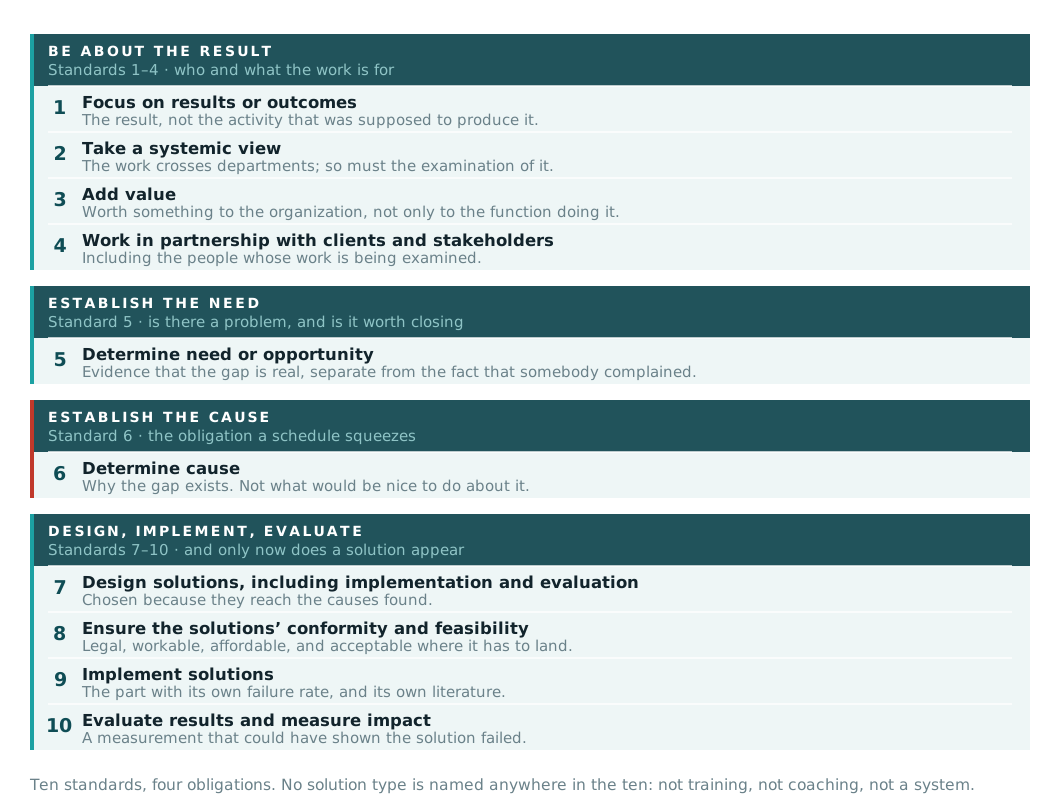
The ten as the society publishes them today. The grouping into four obligations,
and the marking of the sixth, are ours.
Tulser · White Papers · Performance Consulting
04 · continued
What each obligation actually asks you to produce
A standard is only useful if it names something you can be shown to have failed to do. Here is what each of the four requires somebody to be able to put on a table.
| The obligation | What you must be able to put on a table |
|---|---|
| Be about the result standards 1–4 | The measure, its owner, its current and its desired value, and a statement of who else is affected by moving it. Not an objective: a number somebody already publishes. |
| Establish the need standard 5 | Evidence that the gap is real and worth closing, separate from the fact that somebody complained about it. |
| Establish the cause standard 6 | Each cause placed at a level and attached to a condition, with the evidence for it and the limit of that evidence written next to it. |
| Design, implement, evaluate standards 7–10 | Solutions chosen because they reach the causes found, a plan for putting them in place, and a measurement that could have shown they failed. |
Four obligations, four deliverables. A practitioner who cannot produce the third
has not done the work, whatever else is in the folder.
Notice what the ten do not contain. No solution type is named anywhere: not training, not coaching, not a system, not a reorganization. The standards describe an obligation to find out and an obligation to prove, and they are silent on what the answer will turn out to be, which is the only honest position for a discipline that claims not to know in advance.
Why the sixth is marked in red
Determining cause is the expensive obligation. It is the one that requires access to the work, contradicts somebody, and cannot be done from a meeting room. One to five can be satisfied by a well-run conversation; seven to ten by a competent supplier. Six is where the discipline actually lives, and it is the one a schedule reliably squeezes, which is the whole reason this series and the assistant behind it exist.
Tulser · White Papers · Performance Consulting
05 · The return
What an organization gets for working this way
The case for the discipline is usually made as savings, and savings are the least interesting part of it. Five changes follow, and four of them are structural.
| What changes | How you notice |
|---|---|
| The same problem stops coming back | A symptom treated returns on a cycle: the second refresher, the third reorganization of the same team. A cause removed does not. The clearest evidence that an organization is treating symptoms is a calendar of repeats. |
| Arguments get shorter | When the causes are on a page with their evidence, the discussion is about the evidence. When they are not, it is about whose judgement to trust, and that discussion has no end condition. |
| The range of possible answers widens | An organization that asks about causes discovers solutions it does not sell: a form, a timestamp, an authorization, a rota. These are cheap, and they are invisible to anyone who began from a catalogue. |
| The problem finds its owner | Stated as a business result, a problem belongs to whoever reports that result. Stated as an adjective, it belongs to a staff function that cannot fix it and will be judged on not having fixed it. |
| And money is not spent on the wrong thing | The one everybody leads with, and the least durable of the five, because it is only visible in the year you avoid it. |
Five returns. The fifth is the one that gets a business case approved; the first
four are why the capability is worth having permanently.
What kind of claim this table is
These five are practitioner observation, not measured findings. No controlled comparison of organizations that diagnose against organizations that do not exists, as far as we can establish. The next two pages set out what evidence there is, on both sides.
What that is worth in money is a separate question, and number 13 does it. The point here is that the arithmetic is not the argument.
Tulser · White Papers · Performance Consulting
05 · continued
What the evidence actually supports
The discipline as a whole has never been tested as a whole. Two of its components have been, and the gap between them is where an informed reader will push.
| The claim | What supports it | How strong |
|---|---|---|
| Instruction is a weak lever when the obstacle is not ignorance | Behavioral synthesis across domains, and the transfer meta-analyses on the weight of the work environment. | Good, with a transfer caveat. Number 03 sets it out and states the caveat. |
| Design built on analysis outperforms design built on assumption | The meta-analytic work on cognitive task analysis, in general instruction (Tofel-Grehl & Feldon, 2013) and in surgery (Edwards et al., 2021). | Good, and it is the closest thing to a direct test of the front end. |
| Causes sit in the environment more often than in the person | Deming, Rummler and Gilbert: convergent practitioner theory rather than measurement. | Convergent, not measured. Three traditions agreeing is evidence of something; it is not a trial. |
| Running this method makes an organization perform better | Nothing directly. No controlled study exists. | Unevidenced. This is the claim the discipline most wants to make and least can. |
Four claims of descending strength. Quoting the fourth as though it were the
second does the discipline harm, and there has been a good deal of that.
One line of evidence deserves care rather than a footnote, because it is the one most often quoted at this discipline. At the organizational level the association between training and performance is real and small. Kim, Chang and Bell synthesized 159 studies covering just over 75,000 organizations and found a positive but modest relationship, ρ = .13, varying substantially with what was trained, who was trained, how and when the outcome was measured, and the industry it happened in (Kim et al., 2025).
Tulser · White Papers · Performance Consulting
05 · continued
Why this series argues from effect sizes in neither direction
The more important finding is methodological, and it has a consequence for how this series is allowed to argue: one that cuts against us as much as for us.
Reviewing 207 quantitative studies across forty years, Garavan and colleagues conclude that the field’s central difficulty is that training cannot be separated from the system it sits in: the effects are interconnected, time-dependent and bidirectional, and a design that treats training as an isolated cause of firm performance is measuring something the world does not contain (Garavan et al., 2021). Their proposal is to put the system back into the research, which is the same move this discipline makes in the analysis.
The rule it produces
It would be convenient to quote a small effect size as proof that training rarely works. That would be the same error in the opposite direction, and Garavan’s point forbids it: if training cannot be isolated from its context, then neither a large effect nor a small one settles anything about a particular problem in a particular organization.
So the argument here is not statistical, it is diagnostic. Is the thing that is broken the thing training reaches? That question is answered by looking at the work, and the answer is different every time, which is why this series is about a method rather than about a finding.
Tulser · White Papers · Performance Consulting
05 · continued
Why this field has few studies, and why that is not a defect
A reader who checks the references will notice something. The evidence cited across these sixteen numbers is almost entirely meta-analytic, and almost none of it is about performance analysis itself. That is deliberate, and the explanation is part of the argument rather than an apology for it.
Medicine can run trials because it has standard diagnoses and standard interventions. A trial compares the same named treatment for the same named condition across many patients, and the whole apparatus of evidence-based practice rests on that being possible. Performance analysis has neither. Every case is one organization, with its own measure, its own process, its own history and its own binding condition, and the intervention that follows is designed for that case and for no other. There is no standard diagnosis to sample and no standard intervention to randomize.
That is not a weakness of the discipline. It is what the discipline is. A method whose entire purpose is to establish that this problem, in this organization, has this cause cannot also produce a population of identical cases for someone to compare.
The nearest thing to an exception proves the point. Pritchard’s Productivity Measurement and Enhancement System, a structured method in which a unit builds its own measures and reviews regular feedback against them, has been measured at scale: 83 field studies across three decades, large improvements in productivity, effects that persist for years, and results that vary most with how faithfully the method was followed (Pritchard et al., 2008). What could be standardized, the measurement-and-feedback loop, proved measurable, and it works. What cannot be standardized is the diagnosis this series is about: ProMES begins after that question, inside a unit that already knows its own outputs.
Which produces the evidence rule for the whole series
Where these papers make an empirical claim, it rests on a meta-analysis or a systematic review. Where no such synthesis exists, they say so rather than reaching for a single study to fill the gap, because a white paper that cites one paper per assertion looks rigorous and is not. Single studies are the easiest evidence to find and the least likely to survive.
Everything else in these pages falls into one of three categories, and each is labeled: the discipline’s own canon, our own practice over twenty years, or the strongest published objection to what we do. None of the three is dressed as research.
Tulser · White Papers · Performance Consulting
05 · continued
The strongest published case against doing this at all
Cause analysis has a serious critic and it should be read rather than avoided. In BMJ Quality & Safety, Peerally, Carr, Waring and Dixon-Woods set out why root cause analysis in healthcare has so often failed to produce improvement (Peerally et al., 2017). Several of their objections apply to what this series proposes. Four of the five below are answerable. The fifth is not: every analysis here produces a finding for one organization and one decision, and nothing accumulates across them. Anybody adopting this method is buying a local instrument rather than a contribution to a body of knowledge, and that is a real limitation of the discipline as practiced.
| Their objection | Whether it applies here | What we do about it |
|---|---|---|
| “Root cause” is reductionist: it implies one linear cause | Yes. Any method returning “the cause” invites the same error. | The output is a set of causes, each at a level, each with its confidence stated. Never one cause. |
| It is done by local teams without the expertise it requires | Yes, and sharply. This series argues for running the analysis in-house on every request, which is exactly that. | It is the strongest argument for a method with a fixed order of questions and for an assistant that carries the questions rather than the conclusions. It is not a complete answer. |
| Time pressure and hindsight produce “causes of mutual convenience” | Yes. A four-week analysis under a deadline is exposed to this. | Every cause carries its evidence and what would raise confidence, so a convenient one is visible as such. |
| Organizations settle for weak controls: reminders, retraining | Yes, and it is the failure this series exists to prevent. | The order of the six conditions, with knowledge last. The one objection the method is built against. |
| Findings stay inside one organization, so nothing accumulates | Yes. A diagnosis is written for one decision and then filed. | Unresolved. See above. |
After Peerally et al. (2017); the third column is ours.
Tulser · White Papers · Performance Consulting
06 · The posture
The performance consultant
The posture is not new and it is not a job title. The five sections before this one are its history. It is also one of the roles a learning function has to be able to play if it is going to be of use to a business: the destination piece at the end of this series sets out the four models a function can run, and this posture is what carries it across the divide.
What matters is the posture rather than the competence, and the posture is the hard part. It is the one a good investigator takes: do not begin from a suspect, begin from the thing that happened, establish what is actually known, and treat the most obvious explanation as the one most in need of checking (precisely because it is the one everybody has already accepted).
| The posture | What it looks like in a working week |
|---|---|
| Start from the evidence, not the account | Read the number before the meeting about the number. The account is what somebody concluded; the evidence is what happened. |
| Treat the obvious explanation as a hypothesis | It may well be right. It is also the one nobody has tested, because it did not seem to need testing. |
| Go where the work is | The white space between two departments is not visible from either of them, and never from a meeting room. |
| Say what you do not know | A diagnosis that states its own confidence and what would raise it is worth more than a confident one, and survives contact with a skeptical director. |
Four habits, none of which requires a title, a budget or anyone’s permission.
The awkward implication is that the posture is often unwelcome. Establishing a cause means telling somebody that the thing they asked for will not reach it, and doing that on every request rather than on the two a year where there is time. That is a standing capability, not an occasional project, and it is the reason the last paper in this series exists.
Tulser · White Papers · Performance Consulting
07 · The limits
What this is not
A discipline that claims sixty years and a certifying body should be plain about its boundaries. Four of them.
- It is not a change methodology. It establishes what is wrong and what would reach it. Getting two departments to alter a handoff is political work with its own literature and its own failure rate, and nothing in the standards makes it easier.
- It does not guarantee convergence. The claim in section 03 is a standard, not a finding. Two competent analysts following the order will agree far more often than two consultants following their instincts, but “far more often” is not “always”, and anybody who promises otherwise is selling.
- It is not a substitute for management. Deming’s point cuts both ways: if most of what goes wrong belongs to the system, then most of what fixes it is a management decision. An analysis can make that decision informed. It cannot make it.
- The history here is compressed. Four people stand in for several dozen. The chronology is deliberately coarse: we give only what independent library records carry (the founding year, the journal, and the names the society published under) and leave out the founding-meeting detail that circulates in secondary accounts. The standards are quoted from the society’s current wording (ISPI, 2026).
Summary
A field founded in 1962 to promote a teaching method spent sixty years establishing what teaching cannot reach, and dropped the word from its own name to say so. What it left behind is an order of questions, a set of obligations and one uncomfortable habit: check the obvious explanation first, because it is the one nobody has checked.
Tulser · White Papers · Performance Consulting
Run it yourself
Causes, or what you can see?
Ten minutes, on your own organization rather than on a problem. Six questions, and the pattern of the answers tells you more than any of them separately.
1 · The repeats
Which problem has been addressed more than once in the last three years? List the interventions. That is a symptom being treated.
2 · The last three requests
Did each name a solution or a result? Count them. The ratio is your starting position.
3 · The last analysis
When did somebody last establish a cause before money moved, and could you find the document?
4 · The range of answers
In the last year, how many interventions were something other than training, communication or a reorganization?
5 · The owner
Take your largest current performance problem. Whose report does its measure appear on? If nobody’s, that is finding number one.
6 · The sixth standard
Who in your organization is expected to determine cause, has the access to do it, and the standing to contradict a manager?
Tulser · White Papers · Performance Consulting
Where this paper sits
Two problems, one method, sixteen papers
| Business problem | Training request | |
|---|---|---|
| Owned by | The manager or director who owns the result. | L&D and the HR business partner. |
| What it prevents | Spending on the wrong intervention: a system, a reorganization, a hire. | Spending on a program that cannot reach the cause. |
| What it returns | The fix that moves the number, chosen on evidence. | The budget and the working hours that were not spent. |
| Method used | The same three analyses and five questions, which is why one capability serves both, and why the diagnosis no longer has to be bought in case by case. | |
One method, two returns, and a standing capability instead of a standing
consultancy line.
Two models carry the method. Gilbert’s six conditions ask what kind of cause; Rummler and Brache’s three levels ask where it sits. Both are sound and this series uses both, and it leads with Gilbert, because his unit is the accomplishment, which is what an organization already counts, and because his six conditions are the categories an organization can actually change.
Tulser · White Papers · Performance Consulting
Where this paper sits · continued
Where the method comes from
Two further pieces close the set and carry no number, because each points at all the numbered papers. Before the guide sits Arets L&D Business Models, the destination piece for the people who receive the requests: four models a learning function can run, and the route from HR-driven to business-driven. Last sits Solutions that cannot work, the field guide, ordered by the sentence that lands on your desk: seventeen forms a performance problem arrives in, each with an address in one of the numbered papers. Three orders in all: the destination you choose, the question you are on, and the form that landed on your desk.
How this series came about
Human performance technology travels the way a craft does: from hand to hand. Vivian Heijnen and Jos Arets learned the analysis from Dennis Mankin, in San Diego, more than twenty years ago, and have kept in contact with him ever since. Both remain grateful to him: for the rigor of the method as he taught it, and for the leadership he has given performance consulting over a long career.
What followed was twenty years of use. Vivian took the method into organizations in the Netherlands and well beyond them, and what accumulates over that many analyses is largely tacit: the cut nobody thought to make, the question that opens a defensive room, the finding that turns out to be an artifact of the data. Making that knowledge explicit, case by case, is what this series is for. Jos wrote it down as it went, in two books and more than forty articles and blog posts, most of them in Dutch, and one seven-part English series, Is AI the bicycle of the mind?, which number 15 grows out of. The books: Liever (g)een training with Boudewijn Overduin, Kostbaar misverstand with Vivian Heijnen, which this series takes a good deal of its thinking from.
None of that is reprinted here. It has been reworked: brought up to date, tested against the research that has appeared since, and dropped where the evidence no longer carries it. Theory that has never met a client is a position; practice that cannot account for itself is a story. This series is what remains when each is held to the other. Performance Consultant AI carries the same discipline to the desk where the decision is actually made.
About the cases. Every worked case in this series comes from our own practice. Names are changed and details altered so that no organization is recognizable, and the arithmetic reconciles. That is said once, here, rather than under each case: client work is confidential, and a case that named anybody would be a breach rather than a proof.
Tulser · White Papers · Performance Consulting
The series
Sixteen papers, six parts
Number 01 is the map and number 02 is the foundation. From number 05 on, every number is depth on exactly one step of the method. The filled block is the paper you are holding; the two unnumbered pieces close the set.
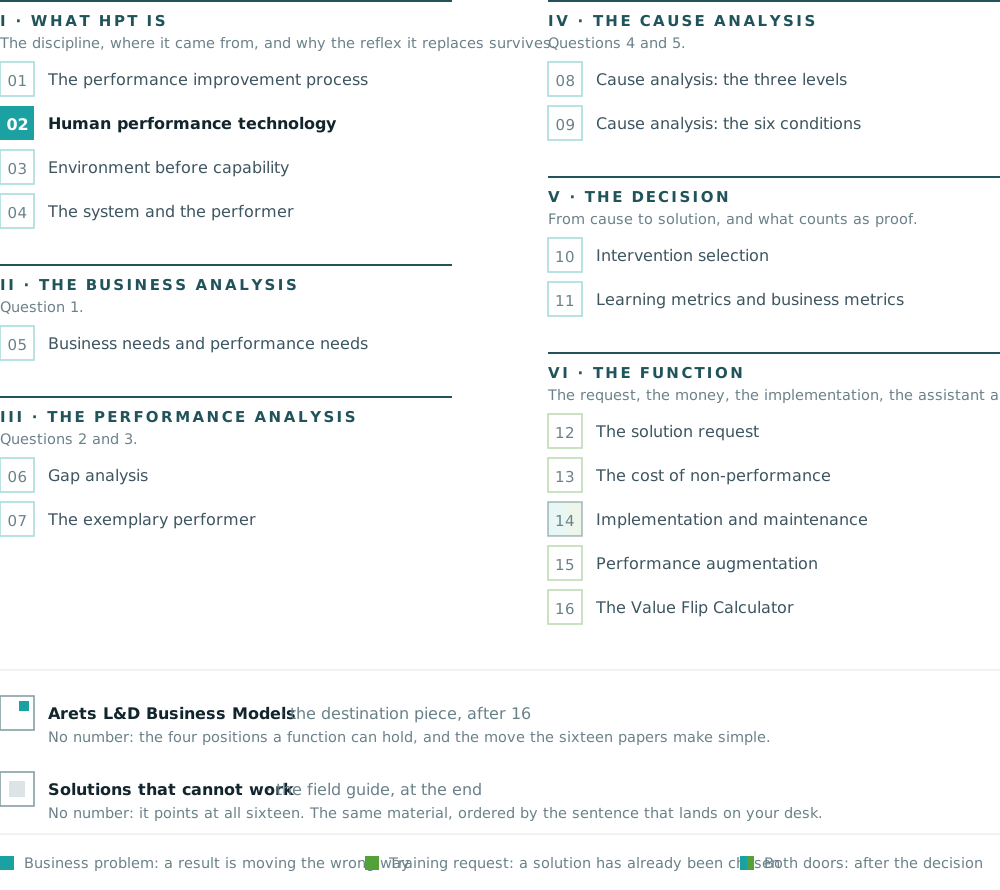
Tulser · White Papers · Performance Consulting
References
Where every claim in this paper comes from
The books behind the series are listed here in full, in the number that carries the lineage, so that they do not recur in every reference list. Kostbaar misverstand, which much of the thinking here comes from, was never translated.
Arets, J., & Heijnen, V. (2008). Kostbaar misverstand: Van training naar business improvement [A costly misunderstanding: From training to business improvement]. Academic Service.
Deming, W. E. (2000). Out of the crisis (2nd ed.). The MIT Press. (Original work published 1986)
Gilbert, T. F. (1978). Human competence: Engineering worthy performance. McGraw-Hill.
Harless, J. H. (1970). An ounce of analysis is worth a pound of objectives. Harless Performance Guild.
Harless, J. H. (1985). Performance technology and other popular myths. Performance & Instruction, 24(9), 4–6.
International Society for Performance Improvement. (2026). Certified Performance Technologist: The ten standards of performance technology. ispi.international
International Society for Performance Improvement. (2004). Definition of human performance technology. In G. A. Rummler, Serious performance consulting according to Rummler. ISPI & Pfeiffer.
Garavan, T. N., McCarthy, A., Lai, Y., Clarke, N., Carbery, R., Gubbins, C., Sheehan, M., & Saunders, M. N. K. (2021). Putting the system back into training and firm performance research: A review and research agenda. Human Resource Management Journal, 31(4), 870–903. https://doi.org/10.1111/1748-8583.12337
Kim, J., Chang, H., & Bell, B. S. (2025). Organizational-level training and performance: A meta-analytic investigation. Journal of Management, 52(5), 1772–1809. https://doi.org/10.1177/01492063251327588
Edwards, T. C., Coombs, A. W., Szyszka, B., Logishetty, K., & Cobb, J. P. (2021). Cognitive task analysis-based training in surgery: A meta-analysis. BJS Open, 5(6), zrab122. https://doi.org/10.1093/bjsopen/zrab122
Kang, S., & Molenda, M. (2018). Judging the quality of instructional design and performance improvement. Performance Improvement Quarterly, 31(2), 189–212. https://doi.org/10.1002/piq.21276
Peerally, M. F., Carr, S., Waring, J., & Dixon-Woods, M. (2017). The problem with root cause analysis. BMJ Quality & Safety, 26(5), 417–422. https://doi.org/10.1136/bmjqs-2016-005511
Pritchard, R. D., Harrell, M. M., DiazGranados, D., & Guzman, M. J. (2008). The productivity measurement and enhancement system: A meta-analysis. Journal of Applied Psychology, 93(3), 540–567. https://doi.org/10.1037/0021-9010.93.3.540
Tofel-Grehl, C., & Feldon, D. F. (2013). Cognitive task analysis–based training: A meta-analysis of studies. Journal of Cognitive Engineering and Decision Making, 7(3), 293–304. https://doi.org/10.1177/1555343412474821
Kaufman, R., & Guerra-López, I. (2013). Needs assessment for organizational success. ASTD Press.
Robinson, D. G., & Robinson, J. C. (1995). Performance consulting: Moving beyond training. Berrett-Koehler.
Mager, R. F., & Pipe, P. (1997). Analyzing performance problems, or you really oughta wanna (3rd ed.). Center for Effective Performance.
Rummler, G. A., & Brache, A. P. (2013). Improving performance: How to manage the white space on the organization chart (3rd ed.). Jossey-Bass. (Original work published 1990)
Tulser · White Papers · Performance Consulting
References · continued
One date, held to what the records support
The society’s founding year and its changes of name are taken from library catalogue records of its own journal and newsletter, which show the society publishing from 1962 and under the name National Society for Performance and Instruction by 1973. Its history page could not be retrieved at the time of writing, so no more precise date is given here than those records support.
Tulser · White Papers · Performance Consulting