


White Papers · Performance Consulting
Both doors · after the decision
The solution was chosen on evidence. Nothing has changed yet.
Implementation and maintenance
The phase of the method that decides how much of the chosen solution's effect survives. What the performance-improvement tradition settled half a century ago, what four decades of implementation research now puts a number on, and how the phase connects back to the causes, sideways to the chosen solution, and forward to the proof.
No. 14 · © 2026 Tulser
In this paper
The decision was right. The Monday stayed the same.
The question
Between the chosen solution and a changed result lies the phase most analyses never plan: implementation. What is it worth, how does it connect to causes, solution and measurement, and what has to be true on the first Monday?
For
Whoever owns the chosen solution: the manager or director who signed it, and the L&D, HR and staff functions accountable for making it land.
Read
24 minutes · with a worked case and a one-page instrument.
| 01 | The missing phase | Where well-chosen solutions go to die. |
| 02 | What the tradition settled | Implementation designed with the intervention, maintenance designed up front. |
| 03 | The multiplier | Installation decides how much of the effect survives: sized by the syntheses. |
| 04 | One chain, four connections | Causes, solution, measurement, program management. |
| 05 | The four working parts | An owner, a Monday, a removal, and a feedback loop the team can see. |
| 06 | The two ledgers | Whether it arrived, then whether it worked: in that order. |
| 07 | The team as implementer | What teams now arrange themselves, and where that authority ends. |
| 08 | Maintenance | The pull of the old way, and what the sustainment research found. |
| 09 | One fix, two rollouts | A worked case: the same remedy, alive in one region and dead in the other. |
| 10 | What this does not claim | Five limits, because the rest is not credible without them. |
| · | Run it yourself | Six lines, before the rollout starts. |
Tulser · White Papers · Performance Consulting
Nothing changes because a decision was made.
Something changes when the Monday changes.
Tulser · White Papers · Performance Consulting
01 · The missing phase
Where well-chosen solutions go to die
Everything before this number ends in a decision: a cause established, a remedy chosen against it, a measure agreed that will count as proof. Between that decision and a changed result lies a phase that most organizations plan as an email, and it is where more analyses are lost than to any error in the analysis itself.
The pattern is recognizable at one glance. The diagnosis was sound, the fix was right, the budget was approved, and six months later the measure sits where it was. The new form exists and the old one is still in circulation. The view was built and nobody's morning includes opening it. The rota was changed on paper and the evening shift never heard. Nobody decided against the solution. It was simply never installed in the work, because installing it was nobody's job with nobody's deadline.
The method itself names this phase. In the performance-improvement tradition the cycle does not end at intervention selection: after the analysis and the selection comes implementation and maintenance, a phase with its own design work, its own owner and its own failure modes (Van Tiem et al., 2012). Number 10 chooses the remedy; number 11 says what may be claimed afterwards. This number is everything in between, and it connects that stretch backward to the causes the analysis established, sideways to the solution that was chosen, and forward to the measurement that will judge it. None of it starts from a blank page.
Why the phase gets skipped
Not carelessness: asymmetry. Choosing a solution is a meeting; implementing one is weeks of unglamorous arrangement that competes with everything else on everyone's desk. The decision has a date and a signature. The installation has neither, unless somebody gives it both. That is the whole discipline of this number, compressed: give the installation what the decision already has (an owner, a date, and a definition of done).
Tulser · White Papers · Performance Consulting
02 · The tradition
What the tradition settled, half a century ago
Implementation is not a modern addition to the method. The discipline settled its two ground rules early, and both run against how organizations naturally behave.
First: implementation is designed with the intervention, not after it. The tradition treats the rollout as part of the solution's design (who will do what differently, what they need in hand on day one, and what happens to the old way of working) specified before anything is bought or built (Van Tiem et al., 2012). A solution whose implementation cannot be described is not yet a solution; it is an intention with a budget.
Second: maintenance is designed up front, because the pull of the old way outlives the launch. Rummler's version of the point is structural: performance is produced by a system, and a system that produced the old behavior for years does not stop doing so because a program ran (whatever was misaligned before the fix will quietly reassert itself unless something keeps the new arrangement in place (Rummler, 2004)). The tradition therefore asks, at design time: who notices drift, on which signal, and with the authority to act on it? A fix without a maintenance answer is a fix on loan.
Both rules have the same consequence for practice. The question how will this be implemented? belongs in the same conversation as which solution do we choose? Not a quarter later, in a project kickoff, when the design decisions that determine the answer have already been made by default. What the tradition could not yet supply was a size: how much does this phase actually matter? That answer arrived from a different research field, and it is the next section.
Tulser · White Papers · Performance Consulting
03 · The multiplier
The size of the phase, measured
How much does implementation matter? The one field that measures it for a living has put a number on it, and the number is larger than almost anything a solution designer can buy.
The landmark synthesis reviewed the results of 542 interventions: 483 of them gathered in five meta-analyses, and 59 further studies that measured the influence of implementation on outcomes directly. Its conclusion carries the whole weight of this number: the level of implementation decides the outcomes obtained, and mean effect sizes run at least two to three times higher when programs are carefully implemented and free from serious implementation problems (Durlak & DuPre, 2008).
Read that as a purchasing decision. An organization that agonizes for a quarter over which remedy to buy, and then delegates the rollout to a newsletter, has optimized the smaller variable. The same solution, at the same price, returns double or triple depending on the phase this paper is about. On the evidence, implementation is the largest effect modifier left after the solution is chosen, which is why the tradition was right to make it a phase of the method rather than an afterthought of the project.
How to read the figures in this section
Everything cited here is a synthesis (Cochrane reviews, meta-analyses, systematic reviews) and nearly all of it was measured in healthcare and prevention programs, because that is where implementation research grew up. The figures are quoted for the sectors they were measured in. What crosses into yours is mechanism and direction, which is the same rule this series applies everywhere else. No figure on this page is a promise about your organization.
Tulser · White Papers · Performance Consulting
03 · continued
Five syntheses, and what each one settles
| The finding | What it means on a rollout |
|---|---|
| A feedback loop moves practice: modestly, dependably | The largest Cochrane review in this field, 292 trials, finds that audit with feedback improves desired practice by 6.2 percentage points on average, with moderate certainty (Ivers et al., 2025). It works best when the figures concern the person or team rather than the institution, are compared against the best-performing peers, arrive through somebody respected, and carry a concrete next step. The feedback loop in section 05 is not decoration; it is the best-evidenced single strategy on this page. |
| A rollout aimed at established barriers beats one aimed at assumptions | Strategies tailored to the determinants actually identified improved professional practice against no strategy or an untailored one: pooled odds ratio 1.56 (Baker et al., 2015). The determinants are this organization's established causes, which the analysis already holds. Same diagnosis, second use. |
| More components do not mean more effect | Across systematic reviews, nobody has found that piling more components onto an implementation reliably beats fewer, better-aimed ones (Squires et al., 2014). The absence travels further than any effect size: a rollout plan is not stronger for being longer. What matters is whether each part is aimed at something established. |
| What a strategy does varies enormously with the setting | The most recent large synthesis finds effects that differ so widely between settings that the average says little about yours (Fontaine et al., 2024). The practical reading: copy no rollout, not even your own last one. Design against this organization's established causes, which is what the analysis was for. |
| The improvement cycle is mostly worn, not run | Of 73 published applications of the plan–do–study–act cycle, two followed all five of its principles, and fewer than one in five documented a sequence of iterative cycles (Taylor et al., 2014). The cycle works as designed, not as branded: small scale first, measured at the rhythm of the work, and actually iterated before anything goes organization-wide. |
Five syntheses, each quoted for the sector it was measured in. The strategies
themselves are nameable: a consensus compilation lists seventy-three of them by name (Powell et
al., 2015), which is useful as a vocabulary and is not evidence that any of them works here.
Note what the five have in common: they route authority back to the analysis. Modern implementation research does not replace the diagnosis with a rollout playbook: it says, from its own data, that no playbook survives contact with a setting, and that the only durable guide is what this organization established about its own causes. The method did not need rescuing. It needed confirming, and it got it.
Tulser · White Papers · Performance Consulting
04 · The connections
One chain, four connections
Implementation is not a project that starts when the analysis ends. It is the same chain, entered further along, and every working connection runs on something the analysis already produced.
| The connection | What crosses it | Where it lives |
|---|---|---|
| Back: to the cause analysis | The barriers a rollout must clear are the causes the analysis established: information, resources and incentives before knowledge, capacity and motives. A rollout tailored to them beats one tailored to assumption (Baker et al., 2015), so the rollout design opens the cause analysis, not a template. | Numbers 08 and 09 |
| Sideways: to the chosen solution | Implementation research's first distinction: the intervention is what you install; the implementation strategy is how you get it used. Keep them separate on paper, or the rollout quietly turns one remedy into a bundle nobody can evaluate: the failure number 10 exists to prevent (Squires et al., 2014). | Number 10 |
| Forward: to the measurement | Two ledgers, read in order: first whether the fix arrived (adoption, fidelity, reach) and only then whether it worked, on the measure the analysis fixed in advance. Read in the wrong order they produce the classic false verdict: a solution declared failed that never arrived. | Section 06 here; numbers 06, 11 and 13 |
| Upward: to program management | Somebody has to run the phase: sequence, decision rights, an escalation route, and the discipline of small scale before organization-wide. The change literature, synthesized, orders the same moves the method already makes: begin from a diagnosis, communicate the why, experiment at small scale, institutionalize what holds (Stouten et al., 2018). | Section 05's owner; the worksheet |
Four connections, one direction of travel: the same evidence that chose the
solution runs the rollout. A rollout that starts from a blank page has thrown the analysis away.
Tulser · White Papers · Performance Consulting
The pilot worked.
The rollout was a different intervention.
Tulser · White Papers · Performance Consulting
05 · The working parts
Four working parts no rollout survives without
Strip every implementation that held from our own practice and four parts remain: our formulation, from twenty years of watching fixes live and die, and each one is checkable in the first week.
| The part | What it is | How its absence looks |
|---|---|---|
| An owner with authority | One named person who owns the change reaching the work, with the authority to alter the schedule, the system access and the form, not only to encourage. | A project group “coordinates”. Everyone informs, nobody installs, and the rollout is a newsletter. |
| A first Monday | A date on which the work is done the new way: visible in the roster, the system, the meeting agenda. Not a launch event: a changed morning. | “From next quarter” arrives and departs. The new way remains available rather than actual. |
| A removal | The old way is taken out of circulation: the old form withdrawn, the old field closed, the workaround’s reason gone. The new way must be the path of least resistance. | Old and new run side by side “during transition”, and the old one wins, because it is the one everybody already knows. |
| A feedback loop the team can see | The measure from the analysis, visible to the people doing the work, at the rhythm of the work: designed the way the feedback evidence rewards: figures at the level of the person or team, a comparison worth having, a concrete next step attached (Ivers et al., 2025). | The number lives in a monthly report two levels up. Drift is discovered at the quarterly review, which is maintenance by autopsy. |
Four parts, one test: could a stranger verify each within a week of the start?
An implementation plan that cannot answer is a communication plan. Our own formulation, from
practice.
Tulser · White Papers · Performance Consulting
06 · The two ledgers
First whether it arrived, then whether it worked
The number that will judge the solution is not the number that steers the rollout. A rollout is measured on two ledgers, and the order in which they are read decides whether the verdict means anything.
| Ledger one · the installation | Ledger two · the result | |
|---|---|---|
| The question | Did the fix arrive in the work? | Did the work's result move? |
| What is counted | Adoption (who actually uses it), fidelity (as designed, or as diluted), reach (everyone it was meant for, or the willing third), sustainment (still in use next quarter): the vocabulary implementation research settled (Proctor et al., 2011). | The measure fixed in the analysis: the gap from number 06, in the money of number 13. |
| Who reads it, when | The owner and the team, weekly, from the first Monday. | Whoever owns the result, at the rhythm the work produces it: judged by the four sentences of number 11. |
| What it can say | “Installed”, “diluted”, “stalled at one region”, and why, while it is still cheap to act. | “Moved”, “did not move”, and, with number 11's discipline, whose doing that was. |
The false verdict, and what it costs
Six months on, the measure has not moved, and the meeting concludes that the solution failed. The first ledger would have shown that it never arrived: a third of the teams adopted it, half of those in a diluted form. Nothing about the solution was tested, only the rollout. Judging the remedy on ledger two while ledger one is empty is the most expensive misreading in this phase, and the cheapest to prevent: the first ledger costs a weekly count the team already sees.
Tulser · White Papers · Performance Consulting
07 · The implementer
The team as implementer, and where that authority ends
The most contemporary change in this phase is not a technique. It is who does the installing. The older picture had somebody above the work rolling change downward. Much of the time, that picture is now wrong, and the method is better for it.
Teams rearrange a growing share of their own conditions: the order of a handover, what a shift starts with, which step quietly disappears because it never helped, what the daily review looks at. Where the chosen fix lives inside that span, the fastest implementation is the team’s own: the four working parts still apply, but the owner is the team, the Monday is next Monday, and the feedback loop is theirs by construction. The research on work redesign points the same way: interventions designed with the people who do the work carry the more promising record (Knight & Parker, 2021), and a team that can alter its own conditions acts on a finding in a week rather than waiting a quarter for permission.
The boundary, stated as precisely as the opportunity
Authority, budget, systems and formal incentives usually sit outside a team’s span. A fix that crosses any of those lines needs the owner with authority from section 05, and asking a team to arrange what it is not allowed to arrange does not empower it. It relocates a management problem to the people who already suffer it. The implementation design therefore starts with one sorting question: which parts of this fix sit inside the team’s span, and which require somebody with a budget line? The first half starts Monday. The second half is the owner’s first task.
Tulser · White Papers · Performance Consulting
08 · Maintenance
The launch fights for attention. Maintenance fights gravity.
Everything up to here gets a fix into the work. Keeping it there is a different problem, and the research that followed programs past their launch says the problem is usually lost: quietly, and without a decision.
The broadest review of what happens after implementation, 125 studies that followed programs into their later years, found partial sustainment more common than continuation of the whole program, even where the initial implementation had fully succeeded; in the studies that assessed fidelity rigorously, fewer than half of the providers still ran the practice at a high level (Wiltsey Stirman et al., 2012). That is a direction, not a fate: the programs studied mostly had no designed maintenance at all, which is precisely the tradition's complaint from section 02. What the finding removes is the comfortable default: the assumption that an installed fix stays installed because nobody decided to remove it. Nobody decides. The old system's pull does not need a decision.
The design answer has four parts, and all four are cheap at design time and expensive after. A drift signal: one named person who notices the old way creeping back, on a defined signal, with the authority to act, not a value in a culture deck. The loop left running: the feedback loop from section 05 drops to a lower rhythm after the first quarter, but it does not stop, because a number nobody sees is a number that drifts. The removal held: a workaround cannot return if its reason is gone, which is why the removal in section 05 is maintenance disguised as implementation. Ownership that survives the project: maintenance transferred by name to the line before the project closes, or it is transferred to nobody.
Tulser · White Papers · Performance Consulting
The old form was still in the drawer.
So the old process was still in the building.
Tulser · White Papers · Performance Consulting
09 · A worked case
One fix, two rollouts
A field-service organization, two regions, one finding: engineers were closing jobs without the customer-approval step, and the rework was traced to exactly those jobs. The chosen fix was the same in both regions: the approval step built into the closing screen. The figures are illustrative; the pattern is from our practice.
| Region North | Region South | |
|---|---|---|
| The owner | The operations manager, with the authority to change the closing screen and the day plan. | A project coordinator, mandated to inform and to encourage. |
| The Monday | From the 4th, jobs could not close without the step; the planners knew it and the day plan absorbed the extra minutes. | “Go-live in Q2.” The new screen became available; the old flow stayed the default. |
| The removal | The old closing path was switched off on the same date. | Both paths stayed open “during the transition period”. |
| The two ledgers | Completion-with-approval on the team screen, weekly, next to the rework figure it was chosen to move: installation first, result second. | Only the monthly operations report, two levels up: ledger two, with ledger one never opened. |
| After two quarters | The step is simply how closing works; rework on those jobs fell and stayed down. | Adoption stalled below half; the verdict “the fix failed” reached the board before anyone had counted who was using it. It was re-launched with a reminder campaign, twice. |
Same diagnosis, same remedy, same systems. The difference is the four working
parts: every one present in the north, every one absent in the south. The re-launch campaigns cost
more than the original fix.
Tulser · White Papers · Performance Consulting
10 · The limits
What this does not claim
Five limits, and the first one protects everything that came before this number.
- Perfect implementation of the wrong solution is still the wrong solution. Nothing in this number substitutes for the analysis. A remedy that cannot reach the established cause fails identically well however cleanly it is rolled out: number 10 owns that argument.
- The figures belong to the sectors they were measured in. The syntheses cited here come largely from healthcare and prevention programs. Their figures are quoted for those sectors; what this paper carries into yours is mechanism and direction, nothing more.
- Modest means modest. The best-evidenced strategy on the list moves practice by single-digit percentage points on average. Implementation multiplies a real effect; it cannot create one: the two or three times of section 03 multiplies whatever the solution is worth, including nothing.
- The four working parts are our formulation. Practice, distilled, not a validated instrument. They are offered as a checklist a stranger can verify, which is what a practice heuristic is for.
- The sustainment evidence is the weakest link, and says so itself. The sustainability research is largely retrospective, with unsettled definitions: its own authors' conclusion (Wiltsey Stirman et al., 2012). The four-part maintenance answer in section 08 is design logic and practice, not a proven protocol.
Summary
Between a chosen solution and a changed result lies a phase the tradition named and the research has now sized: implementation decides how much of the effect survives. It runs on the chain, not beside it: barriers are the established causes, the strategy stays separate from the remedy, the installation is measured before the result is judged, and somebody runs the phase with decision rights and a small-scale start. Four working parts decide most of it; two ledgers keep the verdict honest; and maintenance is designed the day the rollout is, because the old system's pull does not need a decision.
Tulser · White Papers · Performance Consulting
Run it yourself
Six lines, before the rollout starts
Thirty minutes, on the solution you are about to install. A blank on lines one to four is the finding, and cheaper now than in two quarters.
1 · The owner, by name
Who owns this change reaching the work, with authority over the schedule, the system and the form? Split what sits inside the team's own span from what needs a budget line. A committee is a blank.
2 · The first Monday
On which date is the work done the new way? Point to where that date is visible: the roster, the system, the agenda.
3 · The removal
What goes out of circulation on that date? If old and new run side by side, which one wins, and why?
4 · The barriers, from the analysis
Which established causes does this rollout have to clear, and which component of the plan clears each one? A component aimed at nothing established comes out of the plan.
5 · The two ledgers
Which installation figures does the team see weekly: adoption, fidelity, reach? And which result measure is judged later, at what rhythm, by number 11's rules?
6 · The drift signal
A year from now, who notices the old way creeping back: on which signal, with what authority to act?
Tulser · White Papers · Performance Consulting
Where this paper sits
Two problems, one method, sixteen papers
| Business problem | Training request | |
|---|---|---|
| Owned by | The manager or director who owns the result. | L&D and the HR business partner. |
| What it prevents | Spending on the wrong intervention: a system, a reorganization, a hire. | Spending on a program that cannot reach the cause. |
| What it returns | The fix that moves the number, chosen on evidence. | The budget and the working hours that were not spent. |
| Method used | The same three analyses and five questions, which is why one capability serves both, and why the diagnosis no longer has to be bought in case by case. | |
One method, two returns, and a standing capability instead of a standing
consultancy line.
Two models carry the method. Gilbert’s six conditions ask what kind of cause; Rummler and Brache’s three levels ask where it sits. Both are sound and this series uses both, and it leads with Gilbert, because his unit is the accomplishment, which is what an organization already counts, and because his six conditions are the categories an organization can actually change.
Tulser · White Papers · Performance Consulting
Where this paper sits · continued
Where the method comes from
Two further pieces close the set and carry no number, because each points at all the numbered papers. Before the guide sits Arets L&D Business Models, the destination piece for the people who receive the requests: four models a learning function can run, and the route from HR-driven to business-driven. Last sits Solutions that cannot work, the field guide, ordered by the sentence that lands on your desk: seventeen forms a performance problem arrives in, each with an address in one of the numbered papers. Three orders in all: the destination you choose, the question you are on, and the form that landed on your desk.
How this series came about
Human performance technology travels the way a craft does: from hand to hand. Vivian Heijnen and Jos Arets learned the analysis from Dennis Mankin, in San Diego, more than twenty years ago, and have kept in contact with him ever since. Both remain grateful to him: for the rigor of the method as he taught it, and for the leadership he has given performance consulting over a long career.
What followed was twenty years of use. Vivian took the method into organizations in the Netherlands and well beyond them, and what accumulates over that many analyses is largely tacit: the cut nobody thought to make, the question that opens a defensive room, the finding that turns out to be an artifact of the data. Making that knowledge explicit, case by case, is what this series is for. Jos wrote it down as it went, in two books and more than forty articles and blog posts, most of them in Dutch, and one seven-part English series, Is AI the bicycle of the mind?, which number 15 grows out of. The books: Liever (g)een training with Boudewijn Overduin, Kostbaar misverstand with Vivian Heijnen, which this series takes a good deal of its thinking from.
None of that is reprinted here. It has been reworked: brought up to date, tested against the research that has appeared since, and dropped where the evidence no longer carries it. Theory that has never met a client is a position; practice that cannot account for itself is a story. This series is what remains when each is held to the other. Performance Consultant AI carries the same discipline to the desk where the decision is actually made.
About the cases. Every worked case in this series comes from our own practice. Names are changed and details altered so that no organization is recognizable, and the arithmetic reconciles. That is said once, here, rather than under each case: client work is confidential, and a case that named anybody would be a breach rather than a proof.
Tulser · White Papers · Performance Consulting
The series
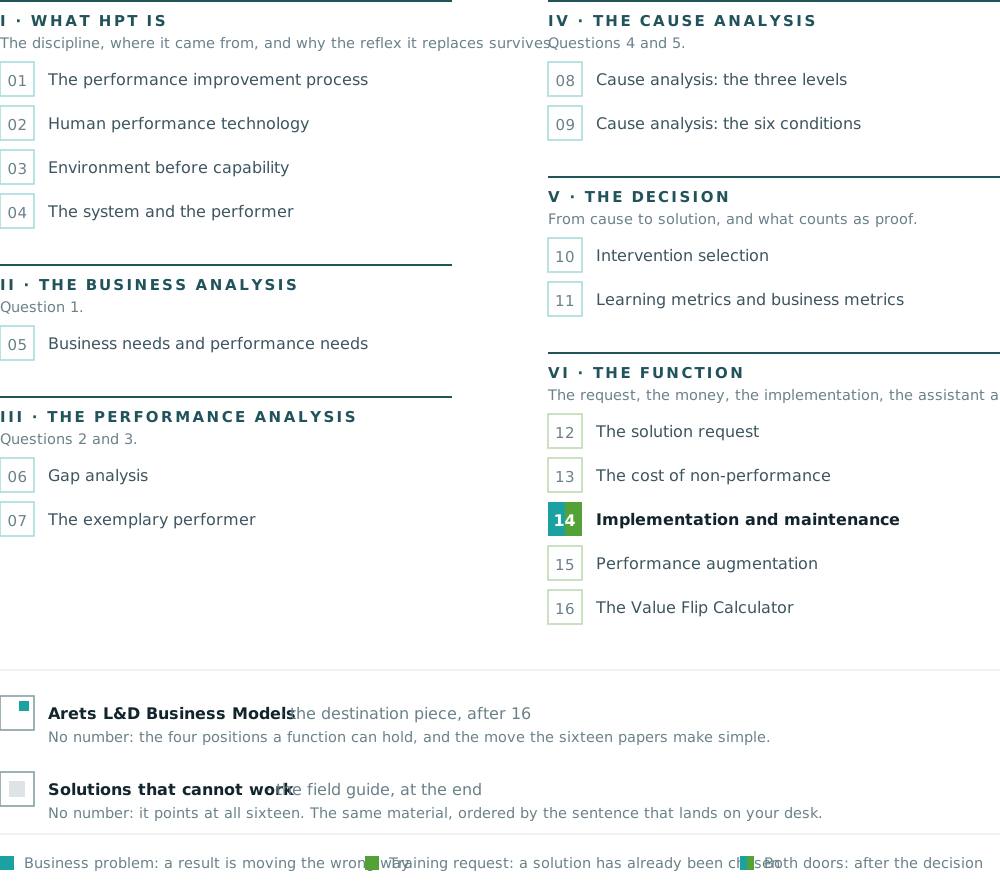
Sixteen papers, six parts
Number 01 is the map and number 02 is the foundation. From number 05 on, every number is depth on exactly one step of the method. The filled block is the paper you are holding; the two unnumbered pieces close the set.
Tulser · White Papers · Performance Consulting
References
Where every claim in this paper comes from
Baker, R., Camosso-Stefinovic, J., Gillies, C., Shaw, E. J., Cheater, F., Flottorp, S., Robertson, N., Wensing, M., Fiander, M., Eccles, M. P., Godycki-Cwirko, M., van Lieshout, J., & Jaeger, C. (2015). Tailored interventions to address determinants of practice. Cochrane Database of Systematic Reviews, 2015(4), CD005470. https://doi.org/10.1002/14651858.CD005470.pub3
Durlak, J. A., & DuPre, E. P. (2008). Implementation matters: A review of research on the influence of implementation on program outcomes and the factors affecting implementation. American Journal of Community Psychology, 41(3–4), 327–350. https://doi.org/10.1007/s10464-008-9165-0
Fontaine, G., Vinette, B., Weight, C., Maheu-Cadotte, M.-A., Lavallée, A., Deschênes, M.-F., Ferrandi, J.-D., Bouchard, J., Fournier, A., Bouix-Picasso, J., Bourbonnais, A., Rouleau, G., & Cassista, J. (2024). Effects of implementation strategies on nursing practice and patient outcomes: A comprehensive systematic review and meta-analysis. Implementation Science, 19(1), 68. https://doi.org/10.1186/s13012-024-01398-0
Ivers, N., Yogasingam, S., Lacroix, M., Brown, K. A., Antony, J., Soobiah, C., Simeoni, M., Willis, T. A., Crawshaw, J., Antonopoulou, V., Meyer, C., Solbak, N. M., Murray, B. J., Butler, E. A., Lepage, S., Giltenane, M., Carter, M. D., Fontaine, G., Sykes, M., … Grimshaw, J. M. (2025). Audit and feedback: Effects on professional practice. Cochrane Database of Systematic Reviews, 2025(3), CD000259. https://doi.org/10.1002/14651858.CD000259.pub4
Knight, C., & Parker, S. K. (2021). How work redesign interventions affect performance: An evidence-based model from a systematic review. Human Relations, 74(1), 69–104. https://doi.org/10.1177/0018726719865604
Powell, B. J., Waltz, T. J., Chinman, M. J., Damschroder, L. J., Smith, J. L., Matthieu, M. M., Proctor, E. K., & Kirchner, J. E. (2015). A refined compilation of implementation strategies: Results from the Expert Recommendations for Implementing Change (ERIC) project. Implementation Science, 10, 21. https://doi.org/10.1186/s13012-015-0209-1
Tulser · White Papers · Performance Consulting
References · continued
Where every claim comes from · continued
Proctor, E., Silmere, H., Raghavan, R., Hovmand, P., Aarons, G., Bunger, A., Griffey, R., & Hensley, M. (2011). Outcomes for implementation research: Conceptual distinctions, measurement challenges, and research agenda. Administration and Policy in Mental Health and Mental Health Services Research, 38(2), 65–76. https://doi.org/10.1007/s10488-010-0319-7
Rummler, G. A. (2004). Serious performance consulting according to Rummler. ISPI & Pfeiffer.
Squires, J. E., Sullivan, K., Eccles, M. P., Worswick, J., & Grimshaw, J. M. (2014). Are multifaceted interventions more effective than single-component interventions in changing health-care professionals’ behaviours? An overview of systematic reviews. Implementation Science, 9, 152. https://doi.org/10.1186/s13012-014-0152-6
Stouten, J., Rousseau, D. M., & De Cremer, D. (2018). Successful organizational change: Integrating the management practice and scholarly literatures. Academy of Management Annals, 12(2), 752–788. https://doi.org/10.5465/annals.2016.0095
Taylor, M. J., McNicholas, C., Nicolay, C., Darzi, A., Bell, D., & Reed, J. E. (2014). Systematic review of the application of the plan–do–study–act method to improve quality in healthcare. BMJ Quality & Safety, 23(4), 290–298. https://doi.org/10.1136/bmjqs-2013-001862
Van Tiem, D. M., Moseley, J. L., & Dessinger, J. C. (2012). Fundamentals of performance improvement: Optimizing results through people, process, and organizations (3rd ed.). Pfeiffer.
Wiltsey Stirman, S., Kimberly, J., Cook, N., Calloway, A., Castro, F., & Charns, M. (2012). The sustainability of new programs and innovations: A review of the empirical literature and recommendations for future research. Implementation Science, 7, 17. https://doi.org/10.1186/1748-5908-7-17
The three books named earlier in this paper are listed in full in number 02, so that they do not recur in every reference list.
Tulser · White Papers · Performance Consulting