
Stop being an Order Taker. Become a Performance Partner.
AI solutionWorkplace learning
Performance Consultant AI
- Strengthen your L&D department by adding business value.
- Find the real cause of every performance problem.
- Support organizations and prevent ineffective training.





- De Zorg Leert Samen


Your team works like performance consultants from day one.
AI solution + Workplace learning
- L&D teams
- HR business partners
- Guidance by leading experts in Performance Consulting
- Fifty real requests from your own desk, about one a week per person
- 12-month license for the Performance Consultant AI
- Personalized for your cases and training requests
- Learn and work with the Performance Consultant AI assistant to amplify yourself and the team
- More online coaching available on request

Six months, four sessions
-
Session 1 · Month 1 · 90 min
The first request, and the first doubt
How to put a real request to the AI assistant, calculate its cost with the Performance Consultant AI Calculator, and what to do the moment you are not sure.
-
Session 2 · Month 2 · 90 min
Reading what comes back
How to read an analysis, and where your judgment overrules it.
-
Session 3 · Month 4 · 90 min
The method behind the answer
Why the AI assistant asks what it asks, so you can push back on the output.
-
Session 4 · Month 6 · 90 min
Judging the work
How to assess an analysis, show what it saves with the Performance Consultant AI Calculator, and take the decision to a manager and to finance.
Working, learning and implementing at once
- Working
Your own requests, analyzed for real.
- Learning
How to ask, read the answer and handle doubt.
- Implementing
The AI assistant in your hands from session one.
Many L&D departments work as Order Takers against their will.
- Managers ask L&D for training as the solution to performance problems.
- 80%-90% of performance problems are not caused by employees but by factors in the work environment.
- Performing a performance analysis is complex.
L&D departments want to be business partners.
- The Performance Consultant AI strengthens every L&D team with business, performance and root cause analyses.
- With the Performance Consultant AI, L&D gets a seat at the management table.
- What normally takes a performance consultant weeks, the AI does in minutes.
What is Performance Consulting?
Twenty years of international experience, packaged in AI
The Performance Consultant AI is not a generic chatbot. It is the seamless technological translation of twenty years of international research and practical application in Human Performance Technology.
The methodology turns the classic question around.
We don't ask:“Which training is needed?”
We ask:“What are the desired results?”
6 examples from our practice
- The Sales Training Request ($5.4M Budget)
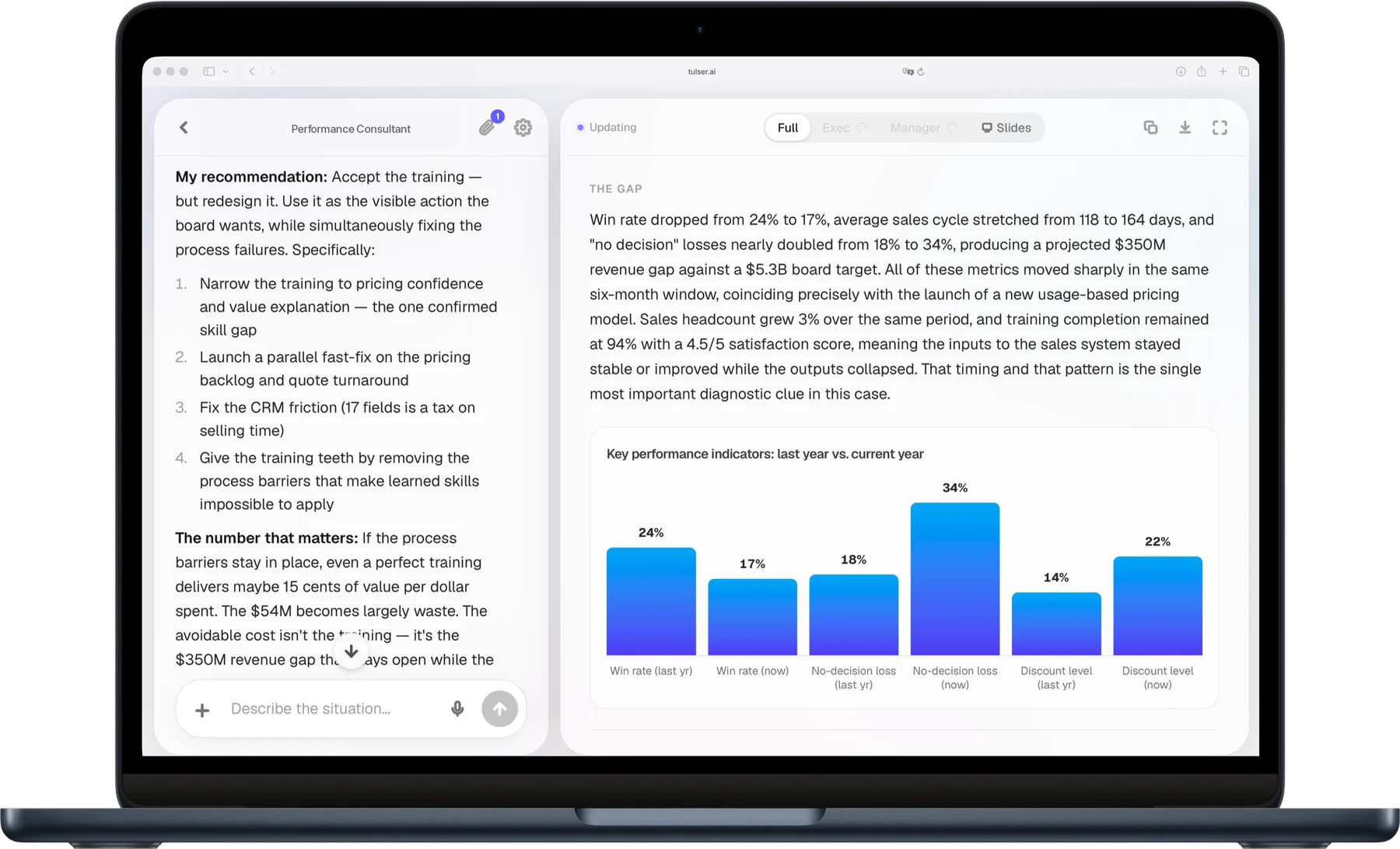
- The Request: A two-day sales training for 10,000 reps. The win rate suddenly dropped from 24% to 17%.
- The AI Diagnosis (Duration: 3 minutes): The AI discovers that the drop coincides exactly with the introduction of a new pricing model. Legal now takes 8.7 days to approve quotes instead of 2.5 days. Deals are stranded in the queue.
- The Advice: This is not a skills problem. Speed up the approval process. Cancel the ineffective training.
- The Onboarding Request (Nursing)
- The Request: A longer onboarding program for new nurses. A third leaves within the first year.
- The AI Diagnosis: The AI sees that the departures concentrate on three wards with structural understaffing. New colleagues there run night shifts on their own within two weeks. The onboarding program is the same on every ward.
- The Advice: This is not a knowledge problem. Don't schedule new colleagues alone at night for the first three months and give them a fixed point of contact. Don't extend the onboarding program.
- The Safety Training Request (Production)
- The Request: A mandatory safety training for 1,200 production workers. The number of incidents rose by 40% in six months.
- The AI Diagnosis: The AI discovers that 80% of the incidents happen on one line, since the switch to a new shift schedule. During a breakdown the break is dropped and the checklist is skipped. Nothing changed on the other lines.
- The Advice: No training for 1,200 people. Restore the break during breakdowns and make the checklist part of the handover. Focus on that one line.
- The Customer Service Training Request
- The Request: A conversation training for 300 customer service employees. Customer satisfaction dropped from 8.1 to 6.9.
- The AI Diagnosis: The AI finds that the drop starts on the day a new knowledge system went live. Search time per question doubled and waiting time rose to eleven minutes. Customers rate the waiting time, not the conversation.
- The Advice: This is not a conversation skills problem. Fix the search function and the most asked questions in the knowledge system. Put the training on hold.
- The Leadership Program Request
- The Request: A one-year leadership program for 120 team leads. In the employee survey, 'my manager gives direction' scores lowest.
- The AI Diagnosis: The AI sees that the lowest scores sit with team leads who have more than 25 direct reports and three ongoing reorganizations. They spend 70% of their time on reporting. Giving direction is not a skills gap here but an agenda problem.
- The Advice: Don't start with a one-year program. Shrink the teams, cut duplicate reporting and give team leads a fixed moment with their team. Then measure again.
- The E-learning Request (Code of Conduct)
- The Request: A new e-learning on the code of conduct for 8,000 employees. The audit found too many deviations from the procedure.
- The AI Diagnosis: The AI discovers that 90% of the deviations sit in one process, where the procedure no longer fits the system. Employees take the detour because the official route requires three approvals.
- The Advice: No e-learning for 8,000 people. Adapt the procedure to the work and remove two approvals. The audit resolves itself in the process, not in the inbox.
The Performance Consulting Approach: Stop unnecessary spending.
CFOs and boards attach little value to classic L&D business cases. Theoretical 'productivity gains' don't convince them.
Our method delivers numbers that finance does respect: Avoided Spend. What happens when you show that a training won't solve the problem? That unnecessary budget flows straight back to the organization.
Calculate your potential: How much of the current L&D budget goes to problems that are not a skill gap? Enter your own team numbers and discover exactly what amount the AI can free up in the first quarter.
The investment in this technology pays for itself on the day your team successfully blocks the first unnecessary training.
Performance Consultant AI Calculator
Calculate what a good analysis saves.
Training spend
0
Our experience
Arets L&D Business Models
Stop being an Order Taker. Become a Performance Partner.
Ink blooming across a white surface in the colours of the brandNo new software. Zero Data Risk.
-
Start tomorrow: Our practice application.
IT approval can take months. Building a high-performing L&D department cannot wait. That is why many clients start right away. They simply fund the transition from their existing L&D training budget.
Your team gets access to our isolated, secure web app. Here they learn to apply the methodology flawlessly in six months. They work exclusively with anonymized data, guided by our experts.
While the team masters this strategic way of working, the IT department integrates the MCP server calmly and securely in the background.
-
We deliver the intelligence. You keep control.
Many organizations don't want to introduce extra AI platforms. That is why we deliver the Performance Consultant AI through the strictly secured Model Context Protocol (MCP).
-
Plug into your existing AI
Our logic integrates as an invisible expert layer in Microsoft Copilot, ChatGPT Enterprise, Claude, or other software.
 Microsoft Copilot
 ChatGPT Enterprise
 Claude
-
100% Data Security
Company data never leaves your own system. We only connect a knowledge layer to your system.
Become a Global Business Partner
Scale your impact. Grow your margin.
We build the AI technology and the methodology. You know the client. To transform L&D departments worldwide, we work with a select network of Business Partners and consultancies.
Integrate our AI into your consultancy portfolio. Guide your clients from Order Taker to Performance Partner and benefit from attractive, recurring license margins. The platform is multilingual and designed for international scale.
Become a Business Partner
Webinars & Insights
Experience the method live. Join L&D leaders worldwide.
In our interactive webinars we share current insights on Performance Consulting and demonstrate how the AI analyzes complex performance problems.

-
Live Demo
From training request to root cause in 3 minutes.
(Every first Thursday of the month)
-
Webinars
Build an L&D Business Case the CFO approves right away.
Globally scalable. Designed for your team.
Our Enterprise licenses are based on the size of the entire department, not on the number of individual users. The license includes our six-month implementation track by default (including the practice application). That is how we secure structural behavior change within your organization, together.