


White Papers · Performance Consulting
Business problem · the decision
The cause is established. Now the organization has to choose something.
Intervention selection
Which remedies actually reach which condition, why the available menu is many times longer than the one anybody uses, and what the evidence says about bundling, which is not what most organizations expect.
No. 10 · © 2026 Tulser
In this paper
A remedy has a reach. Most are bought without asking what it is.
The question
The binding condition is established. Which remedies can actually reach it, which of them is worth buying first, and how do you keep the choice from collapsing back onto the three remedies this organization always buys?
For
Anyone who owns a result or is asked to fix one, and anyone who signs for the remedy: line managers and directors, operations, quality and continuous improvement, finance, OD, HR business partners and L&D.
Read
24 minutes · with a worked case and a one-page instrument.
| 01 | Every remedy has a reach | And a remedy whose reach does not include the cause cannot work, however good it is. |
| 02 | The menu is far longer than the habit | Five options an organization knows how to buy, and everything else it could do. |
| 03 | What reaches each condition | Six conditions, and the solution types that can actually touch each one. |
| 04 | The reach is one question, the level is the other | Why a remedy can reach the right condition and still buy a substrate rather than a result. |
| 05 | How many causes did you establish? | Bundling and combining look identical in a proposal and are opposite in kind, and the evidence bites on only one of them. |
| 06 | Four selection errors | Each one produces a defensible-looking proposal that cannot reach the cause. |
| 07 | The laboratory that bought a portal | A worked case in which the right cause led to the wrong remedy. |
| 08 | What this does not claim | Five limits, because the rest is not credible without them. |
| · | Run it yourself | Six lines, before anybody signs anything. |
Tulser · White Papers · Performance Consulting
An excellent remedy for a condition that is not binding
is an expensive way to change nothing.
Tulser · White Papers · Performance Consulting
01 · The reach
Every remedy has a reach
This is the shortest argument in the series and the one that decides the most money. A remedy acts on one condition. If the condition it acts on is not the one that is binding, the remedy cannot work, not because it is a bad remedy, but because it is pointed somewhere else.
Number 03 gives the synthesized evidence behind that: across domains, what moves behavior most is changing what somebody can reach, and what moves it least is adding to what they know (Albarracín et al., 2024). Read as a claim about frequency it is a strong finding. Read as a claim about reach it is a physical fact, and it is the second reading that governs this decision.
Say it as a physical fact and it stops sounding like a slogan. A training program changes what a person knows and can do. It cannot change how long a file waits between two departments, what the incentive scheme pays for, or whether the parts catalogue takes ninety seconds a line. A new system changes what people can reach. It cannot make anyone want to use it, and it cannot supply the standard nobody ever stated. Each remedy has a reach, and outside that reach it does nothing at all: however well it is designed, however good the supplier, however satisfied the participants.
Which produces the arithmetic that governs this decision. Two conditions have to be true for a remedy to move a number: it has to reach the binding condition, and it has to be executed competently. The organization spends nearly all its attention on the second and almost none on the first, and the second cannot rescue the first. A superbly delivered program aimed at a condition that was not binding produces excellent evaluations and an unchanged result, which is, in our practice, the most common ending in this field.
Two reaches, and this paper takes the second
Number 08 established the level a cause sits at, and a remedy reaches one level. Number 09 established the condition, and a remedy reaches one condition. Both are true at once and they are different constraints: a process redesign and a handoff rule are both process-level, and they reach different conditions. A proposal has to clear both tests, and most proposals have never been asked either.
The rest of this paper is about the second test, in three parts: what the full menu of remedies actually contains, which of them reach each condition, and how to choose between the ones that qualify.
Tulser · White Papers · Performance Consulting
02 · The menu
The menu is far longer than the habit
Ask an organization what it can do about a performance problem and the answer will be a short list: train, communicate, reorganize, buy a system, replace someone. Five options, arrived at by habit rather than by choice.
Now write down what could actually be done about a case where the standard was never stated. Put the number on the report the performer already receives. Put a worked example of good output where the work happens. Change the moment the check occurs. Give the decision to the person doing it rather than to somebody two levels up. Remove a step. Move a queue. Change what gets discussed in the weekly meeting. Alter what the system will not let somebody do. None of those is exotic, all of them are cheaper than a program, and none of them appears on the list of five.
Why the list is five and not fifty
Not ignorance. The five are the remedies this organization knows how to buy: they have a supplier, a budget line, a procurement route and somebody whose job it is to deliver them. The other options require a decision by somebody who does not attend the meeting where the problem is discussed. So the option set is not a limit on imagination; it is a map of the organization’s purchasing machinery.
Which is the ordinary market mechanism running inside the organization: supply creates demand. Where a catalogue exists, requests arrive shaped like the catalogue, and the catalogue then reads as evidence of what the organization needs, because it is full of remedies people asked for.
Which produces a rule about who is in the room, and it does more work than any amount of analytical rigor upstream. If the only people present are the ones who supply training, the remedy will be training. A choice between remedies requires somebody who can commit a process change, somebody who can change a report, and somebody who can change a scheme, which is a meeting most organizations have never held about a performance problem.
Tulser · White Papers · Performance Consulting
03 · The matching
What reaches each condition
Six conditions, and for each one a set of remedies that can physically touch it. Read the table as a filter rather than as a menu: it is far better at ruling options out than at choosing between the ones that remain.
| Binding condition | What can reach it | What cannot, whatever it costs |
|---|---|---|
| Information expectations, standard, feedback | A stated standard in a number; the measure in front of the performer at a usable interval; a job aid at the point of decision; a worked example of the exemplary output. | Training on something people already know. Motivation campaigns. Any remedy that adds knowledge to a person who was never told what good looks like: across domains, adding knowledge is the weakest behavioral lever measured, and changing what somebody can reach is the strongest (Albarracín et al., 2024). |
| Resources tools, time, authority, process | Removing a step; moving a decision to where the work is; a rule governing a handoff; the information traveling with the work; capacity at the queue. | Anything aimed at the person. This is the condition on which the most training is sold and the least training can work. |
| Incentives consequences, intended and accidental | Changing what is reported and discussed; removing an accidental penalty for doing it right; aligning a target with the result actually wanted. | Instruction, tools and communication. If the organization is paying for the other behavior, it will keep getting it. |
The three conditions in the work. The right-hand column is the one that
saves money: ruling a remedy out is a stronger act than choosing one, because it is the part that
can be defended from the analysis.
Tulser · White Papers · Performance Consulting
03 · continued
And the three carried by the performer
These three arrive with the person or are built into them, which is why they are slower and dearer to change, and why the first table is where most of the money is saved.
| Binding condition | What can reach it | What cannot, whatever it costs |
|---|---|---|
| Knowledge and skill | Instruction, and it is the right answer here: designed against the actual task, practiced, with feedback, and followed into the work. What it produces is competence in individual heads, which is the substrate of a collective result and not the result: the next page says what still has to happen. | A better system, a new report, a changed incentive. You cannot arrange your way around an absent skill. |
| Capacity | Selection and placement; task redesign so the capacity is not required; assistive tooling. Selection is a weaker instrument than the field long believed (Sackett et al., 2022). | Training, mostly. This is the boundary where an expensive program meets a limit it cannot move. |
| Motives | Work design, whether the job itself is stimulating, autonomous and connected to other people. Which relocates most of this condition into the first three. | Nearly everything else, including the remedies most often proposed for it. Treat a motives finding as a hypothesis. |
The three conditions in the performer. Only the first of them is what an
organization usually buys, and it is the one condition on this page that instruction can reach.
Tulser · White Papers · Performance Consulting
04 · The level
The reach is one question. The level is the other.
A remedy can reach the binding condition and still land at the wrong level. That is not a refinement. It is the difference between buying a substrate and buying a result.
Instruction is the right answer when the binding condition is knowledge and skill, and the table says so without hedging. What instruction produces is competence in individual heads. Where the result the organization wants is also produced by an individual (an adviser who prices a case correctly, a technician who completes a repair) that is the end of the matter, and the reach question was the only question.
Most results are not like that. Safer handovers, fewer defects, faster adaptation, reliable service: these are produced by teams and held by the organization. There, individual competence is the substrate. Three further conversions have to happen and each can fail on its own: individual competence has to become team capability, capability has to become reliable collective performance, and performance experience has to be retained so the organization still has it next year. Number 14 carries the part of that work a remedy can plan for: implementation by the teams that run the process, and maintenance so the gain is still there next year.
So the selection question has two halves. Which condition does this reach, and at which level does it land? A remedy that reaches the right condition at the individual level, bought against a result produced collectively, will deliver exactly what it promised and evidence nothing the organization asked for. It is the most defensible failure in the profession, because every number in the report is true.
Who arranges the condition, and the part of that which has changed
The table reads as though somebody above the work arranges each condition: a manager sets the standard, a process owner moves the decision, a scheme changes the incentive. That was the older picture and it is no longer the whole one. Teams reshape part of their own conditions: the order of a handover, what is raised at the start of a shift, which step is quietly dropped because it never helped. Where that capacity exists, the cheapest remedy for an information or resources finding is often not bought at all. It is decided by the people doing the work, and what the organization supplies is permission, a little time, and somebody to make it hold.
The boundary deserves the same precision. Authority, budget, systems and formal incentives are usually not within a team’s reach, and asking a team to arrange what it has no power to arrange relocates a management problem onto the people it is failing. Hence a third part to the selection question: who can actually change this, and do they know they are allowed to?
Tulser · White Papers · Performance Consulting
“
A good physician is the practitioner of the diagnosis-before-prescription approach. Also, a good physician does not hawk a single remedy.
Joe Harless
Performance + Instruction, 1985, p. 4
Tulser · White Papers · Performance Consulting
05 · Bundling
How many causes did you establish?
The question that gets asked is whether to buy one thing or several. It is the wrong question, and the evidence that is usually quoted in it does not answer it. The question that matters is how many causes you established.
Start with what needs no study, because the strength of this paper sits there. A remedy that cannot reach the binding condition cannot close the gap, not slowly, not partly, not with better execution. That is section 01, and it follows from what the remedy physically touches.
Now the distinction the evidence turns on, because two moves look identical in a proposal and are opposite in kind. Bundling is adding components to one target because each of them might help: a course, a communication campaign and a new dashboard, all aimed at the same complaint, none aimed at an established cause. Combining is one remedy per established condition when more than one is binding: the authority moved and the standard stated, because the analysis found both. The first is a hedge. The second is the analysis being acted on.
And it is only the first that the evidence bites on
The studies quoted in this argument count components aimed at changing what a professional does, and they ask whether more components produce more effect. That is bundling, measured exactly. Not one of them counts a remedy at the process or organizational level: a step removed, an authority moved, an artifact redesigned so the information travels with the work. A resource remedy plus a team-learning remedy, each aimed at a separately established condition, is not the object either synthesis measured, and no finding from them transfers to it.
Tulser · White Papers · Performance Consulting
05 · continued
What the syntheses actually counted
On bundling, then. Twenty-five reviews of multifaceted against single-component interventions were examined together, and the researchers looked three separate ways for a link between the number of components and the size of the effect. None of the three found one (Squires et al., 2014). That was 2014, and the picture has since been redrawn rather than overturned: pooling 204 studies, multifaceted strategies came out slightly ahead of single ones and the difference did not reach significance, while the variation between studies ran from three-quarters to nine-tenths of the total, and the authors note that the studies which could not be pooled favored multifaceted throughout (Fontaine et al., 2024).
Read that heterogeneity rather than the average, because it is the more useful finding. When what a combination does varies that much between settings, the average tells you almost nothing about yours. What decides the outcome is not how many components were bought. It is whether each one was aimed at something that had been established.
Tulser · White Papers · Performance Consulting
05 · continued
Which is why we combine, and why that is not bundling
Our own practice runs against the headline and with the mechanism, and it is worth saying plainly rather than leaving a reader to infer it.
Most performance problems we are called to have more than one binding condition, and the pair recurs. Something in the work obstructs (a step, an authority, a queue, an incentive pointing the other way) and the conditions that would let a team build and hold the capability are absent. Acting on one of those and not the other reliably disappoints. Clearing the obstruction leaves a team that never converts what it can now do into how it works; strengthening the team learning leaves people who have learned something the work still prevents. Two conditions, two remedies, each measurable on its own. [our practice, from client work; not a measured comparison]
There is a reason that pair recurs. In most organizations the substrate is already in order: people have been trained, they know the rule, they can state it correctly in a test. What is missing is the conversion: from individual competence into team capability, from capability into reliable performance under real conditions, and from performance into something the organization still has next year. A course added to that is a component. A remedy aimed at the conversion that is failing is not.
Where the first rule has been put to a controlled test it also holds. The testing happened in clinical guideline work, because that is where somebody funded the trials, and pooling them shows that a remedy chosen after establishing what was in the way beat one chosen without (McHugh et al., 2026). Take the direction from that and not the size: a figure produced in clinical practice has no claim to hold at the same size in a claims department.
The rule that survives all of it
Not never combine, and not fewer remedies either. One remedy per established condition, each measurable on its own. Bundling by default is the failure: components added because nobody established anything and each of them might help. Combining from causes is the method working.
The second half of that rule is where this paper hands over. A package you cannot take apart afterwards is a package about which nothing can be said afterwards. Number 11 sets out what may then be claimed, and the short version is that a measure which moved is not yet a measure you moved: unanswerable for anybody who bought four remedies at once.
Tulser · White Papers · Performance Consulting
05 · continued
The syntheses, and what each one counted
The figures, for anyone who wants them
Tailoring. A Cochrane review in its fourth update, of interventions tailored to identified determinants of practice: 32 studies, 15 contributing quantitative data, pooled odds ratio 1.56 (95% CI 1.27–1.93) against untailored or no intervention. Cochrane’s own summary calls it a likely slight improvement in guideline adherence, at moderate certainty.
Bundling. An overview of 25 systematic reviews of multifaceted versus single-component interventions in professional behavior change. Three separate dose–response analyses found no relationship between the number of components and effect size; the authors conclude there is no compelling evidence that multifaceted interventions are more effective.
The two findings together, as one instruction
Choose fewer remedies, chosen better. A single remedy aimed at the binding condition has the evidence behind it; a package aimed at everything has cost behind it and an evaluation problem in front of it. And the package has a second defect that shows up a year later: after it, nobody can say which part worked, so the organization has bought a success it cannot repeat.
Tulser · White Papers · Performance Consulting
06 · The errors
Four selection errors that survive a good analysis
Every one of these produces a proposal that looks defensible, cites the analysis, and cannot reach the cause. They are worth naming because each has a specific counter-question.
| The error | How it presents | The counter-question |
|---|---|---|
| The available remedy | The chosen option is the one this organization knows how to buy. The analysis is quoted accurately in the introduction and does not constrain the recommendation. | “Which condition does this reach?” Asked in the room, in those words. A proposal that cannot answer it in one sentence has not been matched to anything. |
| The remedy that reaches everything a little | A program with a communication element, a tooling element and a leadership element. Nothing in it is wrong and nothing in it is aimed. | “If this works, which number moves first, and by when?” A remedy with a reach can answer that. A package cannot. |
| The remedy for the visible half | Two conditions were found. The proposal addresses the one inside the department that is paying, and the handoff with the other department is described as out of scope. | “What share of the gap does the part we are funding account for?” If it is a fifth, say so before rather than after. |
| The remedy nobody has to decide | Chosen because it requires no other department to change anything. Genuinely the easiest to execute, and pointed at whichever condition happens to be locally owned. | “Was this chosen because it reaches the cause, or because it needs no permission?” Usually both are true, and the honest proposal says which came first. |
Four errors, four questions. All four questions are impolite and all four are
cheaper than the proposal they interrupt.
There is a fifth pattern that is not an error but is worth recording: the remedy that reaches the cause and that the organization will not authorize. That happens, and the professional response is to write it down as the finding, record what was chosen instead and why, and say what share of the gap the substitute can reach. An analysis that quietly rewrites itself to match what was affordable has destroyed the only thing it had.
Tulser · White Papers · Performance Consulting
They bought the remedy they knew how to buy,
for the cause they had
correctly established.
Tulser · White Papers · Performance Consulting
07 · A worked case
The laboratory that bought a portal
A regional diagnostic laboratory serving 340 general practices. The measure was the share of test requests arriving complete enough to process without a call back. Desired 95 percent; running at 71. The analysis was good. The remedy was not.
Questions four and five had done their work. The shortfall was uniform across practices, so not a small group of offenders. The requesting doctors could complete a form correctly when asked to, so not knowledge. And the request form itself presented eleven fields, of which four were required only for certain test types and the form did not say which: the standard existed and had never been stated where the work happened. First condition, binding, at the process level.
| What reached the cause | What was bought |
|---|---|
| Conditional fields on the existing form, so that the four situational requirements appeared only when relevant and were named when they did. Two weeks of work by the supplier who already maintained the form | A requester portal. Eleven months, a procurement process, a training program for the practices, and a project board. |
| Estimated reach: the whole of the first condition, which was the whole of the established cause | Actual reach: the portal contained the same eleven undifferentiated fields, because the specification had been written from the old form. |
The analysis was quoted, accurately, on page two of the business case for the
portal. It did not constrain the specification, which was written by a different team.
Completeness eighteen months later: 74 percent. Three points, on a project whose cost is not this paper’s object and which number 13 would have made visible before the decision rather than after.
Tulser · White Papers · Performance Consulting
07 · continued
What we should have done differently
This one is ours to answer for, because the analysis was ours and the recommendation was accepted in the room without the one sentence that would have held it.
The finding was written as “the requirements are not visible at the point of request.” That is true, and it is a description of a condition rather than a specification of a remedy. It was read by a project team, entirely reasonably, as a case for a better requesting system, and a better requesting system is something that can be procured, budgeted and led, which the two-week form change was not.
What the report should have carried, in the same paragraph as the finding, is the reach test in writing: any remedy for this cause must make the four situational requirements appear, named, at the moment the requester chooses the test type. A remedy that does not do this cannot close this gap, whatever else it improves. One sentence, and it would have traveled into the specification, because specifications are written from documents and not from meetings.
The rule that came out of it
State the finding as a condition, and immediately state the acceptance test any remedy must pass. Not the remedy: the test. The remedy is the organization’s to choose and it will often choose differently from you, for reasons that are sometimes better than yours. The test is what makes a different choice checkable rather than merely different.
Tulser · White Papers · Performance Consulting
08 · The limits
What this does not claim
This paper filters remedies. It does not choose between the ones that survive the filter, and five limits follow from that.
- The matching table is a practitioner instrument, not a validated mapping. No study establishes which solution type works for which condition; what the table encodes is the reach argument in section 01, applied case by case. It is strong at ruling out and weak at ranking what remains. [our formulation, drawn from client work; not a published mapping]
- The tailoring evidence is modest and from one setting. It supports the mechanism, there is nothing clinical about “a remedy chosen against an established cause beats one chosen without”, and it establishes no magnitude for commercial work. What would settle that is a trial in ordinary commercial work: units matched on a measure, half receiving a remedy chosen after a structured cause analysis and half receiving the organization’s default for that complaint, measured on a business metric over four quarters. A phased rollout supplies the design almost for free, and as far as we can establish nobody has done it.
- The option set in section 02 is ours, not a published taxonomy. It is what twenty years of analyses have turned up as options that reach each condition. It is useful for opening a choice that had closed, and it is not evidence that any particular option works.
- The level argument is a framework, not a trial result. That individual competence must convert into team capability, collective performance and organizational memory is a conceptual architecture, not a finding. It is testable and has not been tested as a whole.
- Nothing here prices anything. The choice between two remedies that both reach the cause is usually decided on cost against the value of the gap, and that arithmetic belongs entirely to number 13.
Summary
A remedy reaches one condition, and outside that reach it does nothing however well it is executed. The catalogued option set runs to dozens and most organizations choose from five. Matching a remedy to an established cause beats not matching; adding components does not reliably add effect. And a remedy that reaches the right condition at the individual level, aimed at a result a team produces, buys a substrate and reports it as an outcome. So: fewer remedies, chosen better, each with a written test of what it must do, and at which level it has to land.
Tulser · White Papers · Performance Consulting
Run it yourself
Six lines, before anybody signs anything
Twenty minutes, on the proposal currently in front of you. Line two is the one that ends most discussions, and line six is the one that survives you.
1 · The established cause, in one sentence
Which condition, at which level, accounting for what share of the gap. If this cannot be written, the proposal is premature whatever else is true.
2 · Which condition does the proposal reach
Ask the proposer, in those words. Compare their answer to line one. This is the whole paper in one question.
3 · What else could reach it
Name three alternatives that touch the same condition. If you cannot name three, the option set was never opened.
4 · Who has to be in the room
Who can commit a process change, a report change, a scheme change? If none of them is present, the outcome is already decided.
5 · How many components
Count them. For each one, which condition and what share of the gap? Components that cannot answer are cost.
6 · The acceptance test, in writing
Complete this sentence: any remedy for this cause must ___, and a remedy that does not cannot close this gap. Put it in the report, not in the meeting.
Tulser · White Papers · Performance Consulting
Where this paper sits
Two problems, one method, sixteen papers
| Business problem | Training request | |
|---|---|---|
| Owned by | The manager or director who owns the result. | L&D and the HR business partner. |
| What it prevents | Spending on the wrong intervention: a system, a reorganization, a hire. | Spending on a program that cannot reach the cause. |
| What it returns | The fix that moves the number, chosen on evidence. | The budget and the working hours that were not spent. |
| Method used | The same three analyses and five questions, which is why one capability serves both, and why the diagnosis no longer has to be bought in case by case. | |
One method, two returns, and a standing capability instead of a standing
consultancy line.
Two models carry the method. Gilbert’s six conditions ask what kind of cause; Rummler and Brache’s three levels ask where it sits. Both are sound and this series uses both, and it leads with Gilbert, because his unit is the accomplishment, which is what an organization already counts, and because his six conditions are the categories an organization can actually change.
Tulser · White Papers · Performance Consulting
Where this paper sits · continued
Where the method comes from
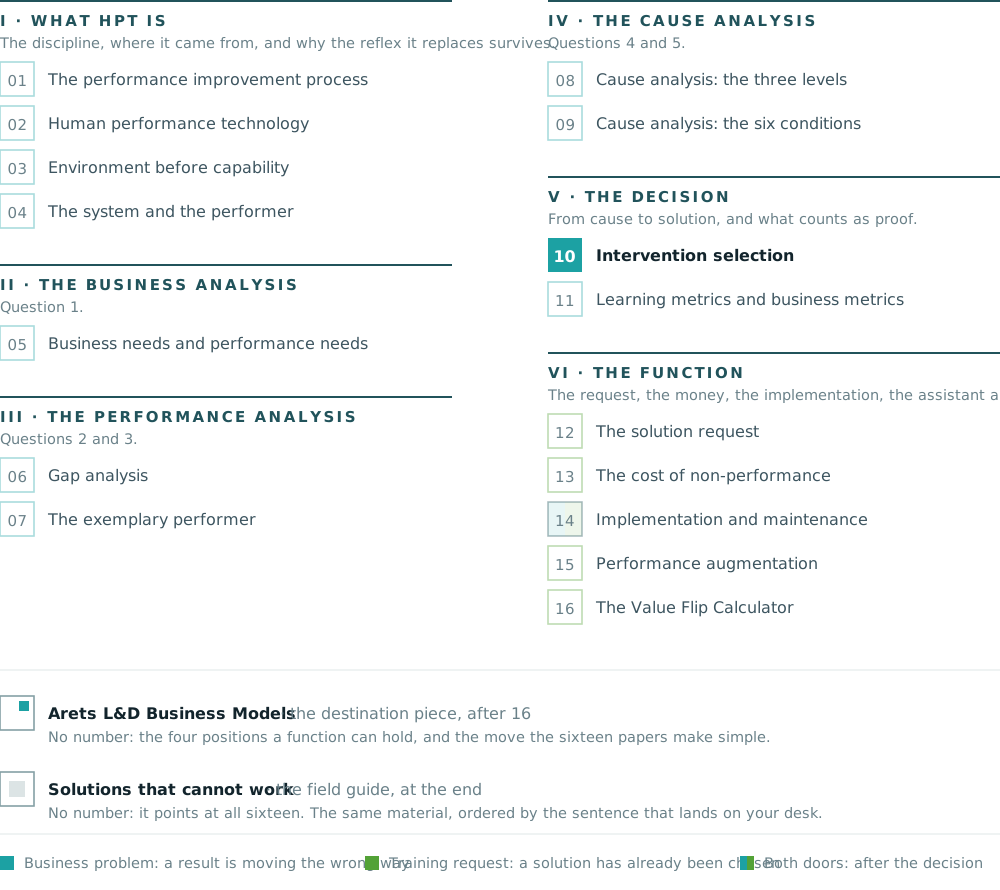
Two further pieces close the set and carry no number, because each points at all the numbered papers. Before the guide sits Arets L&D Business Models, the destination piece for the people who receive the requests: four models a learning function can run, and the route from HR-driven to business-driven. Last sits Solutions that cannot work, the field guide, ordered by the sentence that lands on your desk: seventeen forms a performance problem arrives in, each with an address in one of the numbered papers. Three orders in all: the destination you choose, the question you are on, and the form that landed on your desk.
How this series came about
Human performance technology travels the way a craft does: from hand to hand. Vivian Heijnen and Jos Arets learned the analysis from Dennis Mankin, in San Diego, more than twenty years ago, and have kept in contact with him ever since. Both remain grateful to him: for the rigor of the method as he taught it, and for the leadership he has given performance consulting over a long career.
What followed was twenty years of use. Vivian took the method into organizations in the Netherlands and well beyond them, and what accumulates over that many analyses is largely tacit: the cut nobody thought to make, the question that opens a defensive room, the finding that turns out to be an artifact of the data. Making that knowledge explicit, case by case, is what this series is for. Jos wrote it down as it went, in two books and more than forty articles and blog posts, most of them in Dutch, and one seven-part English series, Is AI the bicycle of the mind?, which number 15 grows out of. The books: Liever (g)een training with Boudewijn Overduin, Kostbaar misverstand with Vivian Heijnen, which this series takes a good deal of its thinking from.
None of that is reprinted here. It has been reworked: brought up to date, tested against the research that has appeared since, and dropped where the evidence no longer carries it. Theory that has never met a client is a position; practice that cannot account for itself is a story. This series is what remains when each is held to the other. Performance Consultant AI carries the same discipline to the desk where the decision is actually made.
About the cases. Every worked case in this series comes from our own practice. Names are changed and details altered so that no organization is recognizable, and the arithmetic reconciles. That is said once, here, rather than under each case: client work is confidential, and a case that named anybody would be a breach rather than a proof.
Tulser · White Papers · Performance Consulting
The series
Sixteen papers, six parts
Number 01 is the map and number 02 is the foundation. From number 05 on, every number is depth on exactly one step of the method. The filled block is the paper you are holding; the two unnumbered pieces close the set.
Tulser · White Papers · Performance Consulting
References
Where every claim in this paper comes from
Albarracín, D., Fayaz-Farkhad, B., & Granados Samayoa, J. A. (2024). Determinants of behaviour and their efficacy as targets of behavioural change interventions. Nature Reviews Psychology, 3(6), 377–392. https://doi.org/10.1038/s44159-024-00305-0
Fontaine, G., Vinette, B., Weight, C., Maheu-Cadotte, M.-A., Lavallée, A., Deschênes, M.-F., Ferrandi, J.-D., Bouchard, J., Fournier, A., Bouix-Picasso, J., Bourbonnais, A., Rouleau, G., & Cassista, J. (2024). Effects of implementation strategies on nursing practice and patient outcomes: A comprehensive systematic review and meta-analysis. Implementation Science, 19(1), 68. https://doi.org/10.1186/s13012-024-01398-0
Harless, J. H. (1985). Invited address: Performance technology and other popular myths. Performance + Instruction, 24(6), 4–6. https://doi.org/10.1002/pfi.4150240603
McHugh, S., Riordan, F., O’Mahony, A., McCarthy, L. J., Contreras Navarro, A., Kerins, C., Murphy, J., Morrissey, E. C., O’Reilly, E. J., O’Connor, S., Adams, D. R., Meza, R., Lewis, C. C., Powell, B. J., Wensing, M., Flottorp, S. A., & Wolfenden, L. (2026). Tailored interventions to address determinants of practice. Cochrane Database of Systematic Reviews, (2), CD005470. https://doi.org/10.1002/14651858.CD005470.pub4
Sackett, P. R., Zhang, C., Berry, C. M., & Lievens, F. (2022). Revisiting meta-analytic estimates of validity in personnel selection: Addressing systematic overcorrection for restriction of range. Journal of Applied Psychology, 107(11), 2040–2068. https://doi.org/10.1037/apl0000994
Squires, J. E., Sullivan, K., Eccles, M. P., Worswick, J., & Grimshaw, J. M. (2014). Are multifaceted interventions more effective than single-component interventions in changing health-care professionals’ behaviours? An overview of systematic reviews. Implementation Science, 9, 152. https://doi.org/10.1186/s13012-014-0152-6
The three books named earlier in this paper are listed in full in number 02, so that they do not recur in every reference list.
Tulser · White Papers · Performance Consulting