


White Papers · Performance Consulting
Business problem · question 1
Somebody wants something done, and nobody has said what would count as done.
Business needs and performance needs
Three words used as if they meant the same thing, the difference between a symptom and a cause, and the four ways a problem gets worse while nobody is closing it.
No. 05 · © 2026 Tulser
In this paper
Activity is not performance. Performance is not a result.
The question
Somebody has described a problem and asked for something. Is what they described a business need or a performance need, is what I am looking at a symptom or a cause, and what happens to it if nobody acts?
For
Anyone who owns a result or is asked to fix one: line managers and directors, operations, quality and continuous improvement, HSE, OD, HR business partners and L&D.
Read
20 minutes · with a worked case and a one-page instrument.
| 01 | Three words | Activity, performance and result, and why the confusion is expensive. |
| 02 | The two needs | A business need is counted. A performance need is done. Requests name the second. |
| 03 | Symptom or cause | Why a symptom is more convincing than a cause, and how to tell them apart. |
| 04 | Numbers that are not results | Activity, mood, intention and compliance, and the test that separates them. |
| 05 | When there is no number | The absence is the finding, and usually the explanation. |
| 06 | What doing nothing costs | Four ways an untouched problem gets worse, and one of them is invisible. |
| 07 | The safety program that was a paperwork problem | A worked case, from one request to one measure nobody had split. |
| 08 | What this does not claim | Four limits, because the rest is not credible without them. |
| · | Run it yourself | Two needs, one measure, on the request in front of you. |
Tulser · White Papers · Performance Consulting
Nobody buys activity on purpose.
It is simply the only column you can order.
Tulser · White Papers · Performance Consulting
01 · Three words
Activity, performance and result
Three words do most of the damage in this discipline, and they do it by being used interchangeably in rooms where money is committed. They are not synonyms. They are a chain, and every link in it can break.
Activity is what people do. Attending, reading, discussing, completing. It is countable the day it happens, it belongs to whoever paid for it, and, this is the part that matters, it moves whatever else is true. A course runs whether or not anyone could have used it, and the completion rate is unaffected by whether the work changed.
Performance is what people leave behind. Not the doing but the thing done: the report filed, the fault fixed at the first visit, the order picked correctly. Gilbert put the distinction at the center of the field half a century ago, separating behavior from accomplishment and observing that only the second has any value to anybody (Gilbert, 1978). It is countable within weeks, it belongs to the line, and it moves only if the conditions around the person allow it to.
A result is what the business counts. Claims cost, on-time delivery, first-time fix rate, days sales outstanding. It is countable over a quarter, it belongs to a director, and it moves only if the accomplishment underneath it happens to be the one that drives it.
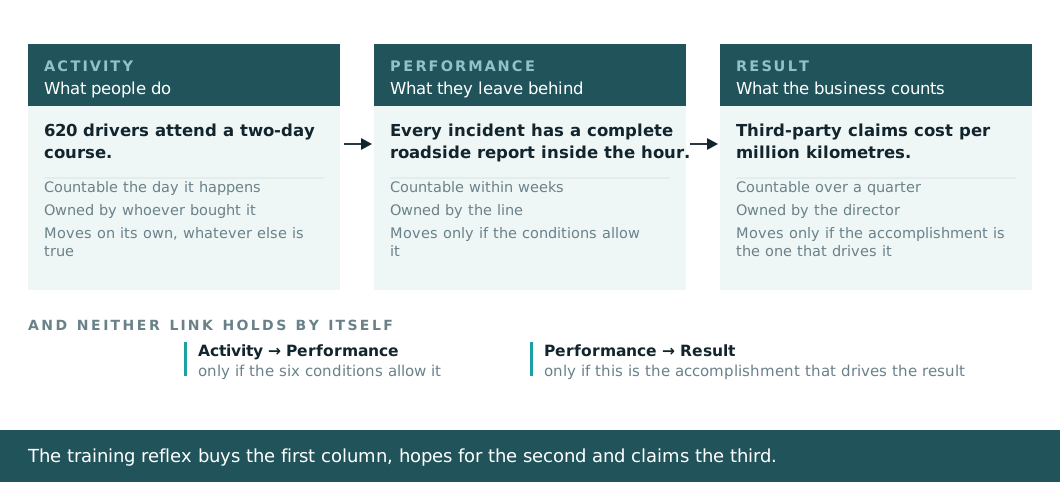
Three columns, two links, and neither link holds by itself. Establishing that
they do is what the rest of the analysis is for.
Tulser · White Papers · Performance Consulting
01 · continued
Why the confusion is expensive rather than merely untidy
The distinction is old and it has been measured. The transfer literature exists precisely because activity and accomplishment came apart so reliably that somebody had to study the gap: a large meta-analysis found that what happens to an accomplishment after a course depends far more on the work environment than on anything in the course (Blume et al., 2010), and the work on sustainment found the same for whether it lasts (Hughes et al., 2020). Reviewing forty years of the organizational-level research, Garavan and colleagues reach the sharper version: training cannot be separated from the system it sits in at all, which is why the effects in that literature are so heavily conditioned (Garavan et al., 2021).
So if the three words were simply imprecise, this would be a matter of style. They are imprecise in one direction, and that direction has a price. Harless named the consequence forty years ago and it has not needed restating since: what costs too much is not the analysis but the absence of one (Harless, 1985, p. 6).
Activity is the only one of the three that can be bought. There is no market for accomplishments and no supplier of results. There are, however, a great many suppliers of activity, and every one of them can quote a price, a date and a headcount by Friday. So the column that is easiest to purchase is the column furthest from the thing anybody wanted.
What follows is a substitution nobody decides on. The organization buys column one, hopes for column two, and, when the invoice is justified twelve months later, reports on column three, or on whatever in column three happens to have moved. The chain is never tested, because testing it would require establishing the two links, and establishing them takes longer than buying the course.
The sentence that gives it away
“We rolled out the program to nine hundred people and engagement is up four points.” Column one and a number that is not in column three, joined by a conjunction doing the work of an argument. Nobody is lying. The two facts are both true, and neither of them is evidence about the other.
The discipline exists to interrupt that substitution, and it does so at exactly one point: before the money moves. Afterwards there is nothing to interrupt: there is only a report to write, and reports about activity are easy to write well.
Tulser · White Papers · Performance Consulting
02 · The two needs
A business need is counted; a performance need is done
The first question of the analysis is not “what is the problem?” It is “which of the two kinds of need am I holding, and is the other one missing?”
| Business need | Performance need | |
|---|---|---|
| What it is | A result the organization already counts, moving in the wrong direction. | What people would have to accomplish for that result to move back. |
| Stated as | Claims cost per million kilometers rose from $34k to $49k in two years. | Every incident has a complete roadside report inside the hour. |
| Who owns it | A director, whose report it appears on. | The line, whose people produce it. |
| How you know it moved | The measure the organization already publishes. | A count of accomplishments, which usually has to be established. |
| Which one arrives | Almost never | Almost always: dressed as a solution. |
Two needs, and requests reliably carry the second one only. The first has to be
reconstructed, which is why the analysis begins where it does.
A request is a performance need with a solution already fastened to it. “We need a safety culture program” contains a view about what people should be accomplishing, driving more carefully, and a view about how to get there. What it does not contain is the result. Nobody has said which number is moving, by how much, on whose report.
Mager and Pipe built a method on the same observation: describe the discrepancy before accepting the remedy offered with it (Mager & Pipe, 1997; Robinson & Robinson, 2008). The rule underneath both needs is older and blunter. A need is a gap in results, never a gap in means, so a course, a system or a campaign can never itself be the need, whatever word is put in front of it (Kaufman & Guerra-López, 2013). Number 02 sets out where that rule comes from.
That is not evasion. The person making the request is usually the person furthest from the number, and the number is not on their report. They have described the part of the problem visible from where they stand, and they have done it in the only vocabulary their organization gives them, which is the vocabulary of activity.
Tulser · White Papers · Performance Consulting
02 · continued
Reconstructing the missing half
So the analyst’s job at this question is reconstruction, and there is one question that does most of it.
The reconstruction, in one question
Ask: if the people you are describing did this perfectly tomorrow, which number on somebody’s report would be different in three months, and by how much? A business need produces an answer with a name and a figure in it. A preference produces a pause.
Tulser · White Papers · Performance Consulting
“
“Analysis costs too much” is a myth. The thing that costs too much is no-analysis.
Joe Harless
Performance + Instruction, 1985, p. 6
Tulser · White Papers · Performance Consulting
03 · Symptom or cause
Why a symptom is more convincing than a cause
A symptom is not a bad guess at a cause. It is a different kind of object, and it has three properties that make it far more persuasive than the thing actually producing the trouble.
It is visible. Somebody noticed it, which is why it is on the table at all. A cause that nobody has noticed has no advocate in the room.
It is recent. Symptoms announce themselves; causes have usually been running for two years. The thing that just happened feels like the thing that is happening.
It invites action this week. There is always something to do about a symptom: talk to someone, add a check, send a reminder, run a session. Acting on a cause typically requires two departments and a quarter, which is the same as saying it requires a decision nobody in the room can take alone.
| What arrives | Read as a symptom, it says | Read as a cause, it asks |
|---|---|---|
| Incidents are up | People are being careless. | What changed in the work that makes the careful thing harder? |
| The survey score fell | Morale is a problem. | What are people being measured on that conflicts with the work? |
| Handoff errors | The night shift is weak. | Who owns the handoff, and is it timed anywhere? |
| Sales are down in one region | That team needs development. | What do the other regions have that this one does not? |
The left-hand column is what gets said. The right-hand column is what the analysis
substitutes for it, and it is slower, less satisfying and correct more often.
The practical rule is not to distrust symptoms. It is to treat every symptom as a location rather than an explanation: this is where the trouble surfaces, which is rarely where it starts. That distinction is the whole of Rummler’s argument about systems, and the reason he insisted a good performer in a bad system loses almost every time (Rummler & Brache, 2013). Number 08 takes the question of where a cause actually sits, and number 09 what kind of cause it is.
Tulser · White Papers · Performance Consulting
04 · The near misses
Numbers that are not results
The commonest failure at this question is not the absence of a number. It is a number that satisfies everyone and describes nothing the business runs on.
Four of them turn up again and again. Each is a real measurement, collected in good faith, and each answers a question other than the one the analysis is asking. They are dangerous precisely because they close the conversation: a figure has been produced, so the first question feels answered.
| What it counts | Why it is not the result | What sits behind it |
|---|---|---|
| Activity | Courses delivered, tickets handled, visits made. It counts what the organization did, not what changed because of it. | Ask what the activity was supposed to produce, and count that. |
| Mood | Engagement, satisfaction, confidence. Real and worth knowing, but it moves for reasons no intervention controls and no operations meeting acts on. | Ask what people said they could not do, and count that. |
| Intention | Willingness to recommend, stated commitment, post-course confidence. What people expect of themselves, collected before the work has tested it. | Wait for the accomplishment, then count it. |
| Compliance | Completion rates, attendance, sign-off. It counts whether a requirement was met, which is a different claim from whether the desired level worked. | Ask what the desired level exists to prevent, and count that. |
Four measures that pass for results. Each can be true and still leave the
organization unable to say what is going wrong. [practitioner classification, not a
measured taxonomy]
The test is one question: if this number improved by a tenth and nothing else changed, would anybody outside this room notice? A business result survives it. Activity, mood, intention and compliance do not, because each of them can move on its own while the work stays exactly as it was.
The third has the most published evidence against it. A recent synthesis of what determines behavior ranks stated intention and belief well below anything that changes the situation somebody is acting in (Albarracín et al., 2024). Measuring what people say they will do is measuring the wrong end of the chain.
Tulser · White Papers · Performance Consulting
04 · continued
And a caution about the mood measures
The second of the four deserves protecting from the argument this paper has just made about it.
A caution about the mood measures
None of this says engagement or satisfaction is worthless. They are often the earliest signal that something in the work is wrong, and dismissing them is its own kind of blindness. The claim is narrower: a mood measure tells you to look, and cannot tell you what to fix. Treat it as the request in section 02: the thing that needs translating, not the translation.
Tulser · White Papers · Performance Consulting
05 · The blank
When there is no number
Often there is no measure, or the measure exists and nobody has looked at it for two years. That is not an obstacle to the analysis. It is the first result of the analysis.
A result that nobody counts is a result nobody owns, and a result nobody owns has been drifting for as long as it has existed. The absence usually explains the duration of the problem better than any cause found later. If the organization had been counting, somebody would have noticed; the fact that the complaint arrived as an adjective is evidence about the measurement system, not only about the work.
| What you find | What it means | What to do this week |
|---|---|---|
| Nothing is counted | The result has no owner. Establishing the measure is the intervention, or at least its first half. | Find the nearest thing that is counted and split it, rather than building a new instrument. |
| It is counted but not read | It has an owner in name. The number exists in a system nobody opens. | Put it on one page, in front of the person whose report it belongs on, and watch what they say. |
| It is counted at the wrong grain | An annual total hides a weekly problem; a national figure hides one site. | Cut it by site, shift, product, customer type: one cut that has never been made. |
| Two functions count it differently | The disagreement is itself a finding, and often the whole one. | Reconcile the definitions before doing anything else. This is frequently where the problem ends. |
Four kinds of blank, four different first moves. None of them requires a
measurement project.
The instinct at this point is to commission something: a dashboard, a baseline study, a measurement framework. Resist it for a fortnight. Organizations count far more than they read, and the measure that will settle the question is usually already sitting in an operational system, uncut and unopened.
Tulser · White Papers · Performance Consulting
A problem nobody counts
has been getting worse for as long as it has existed.
Tulser · White Papers · Performance Consulting
06 · Doing nothing
Four ways a problem gets worse while nobody closes it
Every business case is a comparison against doing nothing, and doing nothing is almost always modeled as standing still. It is not standing still. It has a direction, and the direction is down.
| What happens | How it shows | Why it is missed |
|---|---|---|
| It compounds | The cost recurs every year, and the base it recurs on drifts upward with volume. | Business cases quote a single year, which understates a standing loss by whatever the horizon is. |
| It migrates | People build workarounds. The workaround becomes the process, and now two defects need repair. | The workaround is invisible by design: it exists because somebody solved a problem quietly. |
| It normalizes | The number becomes the expected number. Next year’s target is set from it, and the loss is now the plan. | Nothing is written down at the moment this happens. It is simply how the budget gets built. |
| It is priced in | The cost enters a line item (freight, credits, overtime, agency cover) and stops being attributable to anything. | Once it has a home in the accounts it is a cost of doing business, and nobody audits those. |
Four mechanisms, and the fourth is the one that ends the conversation for good:
a problem that has been absorbed into a budget line no longer looks like a problem.
What kind of claim these four are
Practitioner observation rather than measured findings. No body of research counts how often an unclosed gap compounds, migrates, normalizes or gets priced in: the fourth mechanism hides the phenomenon from anybody trying to study it.
What would settle it: a study tracking measures an organization identified as problems and then did not act on, against comparable measures that were acted on. The third mechanism would be the most visible, because targets are documented.
Tulser · White Papers · Performance Consulting
06 · continued
The fourth is how expensive problems become permanent
Deming’s estimate is the background to all four: most of what goes wrong belongs to the system, and the system belongs to management (Deming, 2000, p. 270). A problem left alone is not a problem waiting; it is a system continuing to produce what it was built to produce.
The fourth deserves emphasis because it is how expensive problems achieve permanence. Nothing has been decided. Somebody, three years ago, made an allowance because the expedited freight kept recurring; the allowance was reasonable; and from that quarter on, the freight was a cost rather than a symptom. The measure that would have shown the problem still exists. It is now labeled as the solution to it.
What this paper does and does not compute
This paper establishes that an unclosed gap has consequences and of what kind. It states what the case below was costing, because a business need with no value attached is not yet a business need. It does not set out the arithmetic itself (how a gap is valued, what a proposed solution costs in full, how the two returns are counted) because that is one instrument with one home. Number 13, which carries the Performance Dividend Calculator, is where the method lives.
Tulser · White Papers · Performance Consulting
07 · A worked case
The safety program that was a paperwork problem
A national haulage business, 480 drivers, 62 million kilometers a year. The figures are illustrative and reconcile from the rates stated with them.
The request was specific and well argued. Two days of safety culture training for every driver, supported by a toolbox-talk program and a refreshed set of standards. The board had asked for it. The transport director had asked for it twice.
Nobody had stated a business need. When somebody looked for one, the number everybody assumed was moving turned out not to be: at-fault incidents had run at 214 a year for three years, flat. What had moved was third-party claims cost, from $2.1M to $3.07M over the same two years: a rise of nearly half on a stable incident count.
| The first question, answered | |
|---|---|
| The request | Two days of safety culture training for 480 drivers. An activity, priced and schedulable. |
| The symptom | “Incidents are up and the drivers have stopped caring.” Incidents were not up. They had been flat for three years. |
| The business need | Third-party claims cost, $2.1M to $3.07M in two years. On the transport director’s report every month. |
| The split nobody had made | Incidents with a complete roadside report inside the hour settled at $6,800 on average. Incidents without one settled at $19,400. |
| The performance need | Not safer driving. A complete roadside report, inside the hour, on every incident. 40% of incidents had one. |
| What doing nothing costs | If every incident were reported completely, the same 214 incidents would settle at $1.46M. The difference is $1.62M (€1.42M) a year, recurring. |
One request, one symptom, one business need and one performance need, and the
request addressed none of them.
Tulser · White Papers · Performance Consulting
07 · continued
What the split did to the conversation
Nothing about the cause had been established yet. The first question alone changed the conversation in three ways, before anyone had been to a depot.
The problem changed hands. It stopped being a driver-behavior matter and became a claims matter, because claims cost sits on the transport director’s report and always had. Nobody had to be persuaded to care about a number they already published.
The activity lost its justification. Two days of safety culture training addresses driving. The measure that was moving is settled by paperwork completed at the roadside, in the twenty minutes after an incident, by a driver who is shaken and standing in the rain. Nothing in the proposed program reaches that.
And somebody was already achieving it. One depot ran 71 percent complete reports against a national 40. Its transport planner had printed the form on a single sheet, put a copy in the door pocket of every cab, and made a habit of ringing any driver who called an incident in to walk them through it. Nobody had asked her to do this, and nobody outside the depot knew she did.
Where the cause turned out to sit
The report lived in a portal that required a company login and a stable connection, and the session timed out after fifteen minutes. At the roadside, in the rain, on a phone, with a police officer waiting, it could not be completed, so it was completed later, from memory, without the photographs. That is not an attitude. It is a condition of the work, and number 09 is where such conditions are named.
The intervention that followed was a laminated one-page form, a photograph checklist and a phone number. What it cost is a matter for number 13. What matters here is that none of it would have been found by anybody answering the request as it arrived.
Tulser · White Papers · Performance Consulting
08 · The limits
What this does not claim
An argument this convenient for one side deserves its boundaries stated plainly. Three of them.
- Activity is not worthless. Some accomplishments genuinely require instruction, and where knowledge is the binding condition, teaching it is the fix rather than a substitute for one. The claim is about the order of establishment: activity is what you buy last, once you know what accomplishment it has to produce.
- Not every request hides a different problem. Sometimes the requester has the business need in their head and simply did not say it, and thirty minutes of conversation produces it intact. The analysis is not an accusation, and treating every request as a misreading is its own reflex.
- The two links are claims, not findings. That an accomplishment drives a result, and that conditions permit the accomplishment, are propositions this paper says must be established. It does not establish them. Numbers 06 to 09 do that work, and they can fail.
Summary
Activity is what can be bought, performance is what has to be produced, and a result is what somebody already counts. A request names the middle one and prices the first. The first question of the analysis is to find the third, and to notice what it has been costing while nobody was looking at it.
Tulser · White Papers · Performance Consulting
Run it yourself
Two needs, one measure
Fifteen minutes, on the request in front of you now. Answer these six and you have question one. Leave one blank and you have found the first thing to establish.
1 · The request, written exactly as it reached you
Underline the activity it names. There will be one.
2 · The accomplishment behind it
If these people did it perfectly tomorrow, what would they be leaving behind that they are not leaving behind now?
3 · The result that accomplishment would move
Name the measure and the person whose report it appears on. If you cannot, that is finding number one.
4 · Symptom or cause
Is what you were told where the trouble surfaced, or where it starts? What would have to be true for it to be the second?
5 · The split nobody has made
Cut the measure one way it has never been cut. Which cut, and what did it show?
6 · What another year of this costs
Compounding, migrating, normalising, priced in, which of the four is already happening?
Tulser · White Papers · Performance Consulting
Where this paper sits
Two problems, one method, sixteen papers
| Business problem | Training request | |
|---|---|---|
| Owned by | The manager or director who owns the result. | L&D and the HR business partner. |
| What it prevents | Spending on the wrong intervention: a system, a reorganization, a hire. | Spending on a program that cannot reach the cause. |
| What it returns | The fix that moves the number, chosen on evidence. | The budget and the working hours that were not spent. |
| Method used | The same three analyses and five questions, which is why one capability serves both, and why the diagnosis no longer has to be bought in case by case. | |
One method, two returns, and a standing capability instead of a standing
consultancy line.
Two models carry the method. Gilbert’s six conditions ask what kind of cause; Rummler and Brache’s three levels ask where it sits. Both are sound and this series uses both, and it leads with Gilbert, because his unit is the accomplishment, which is what an organization already counts, and because his six conditions are the categories an organization can actually change.
Tulser · White Papers · Performance Consulting
Where this paper sits · continued
Where the method comes from
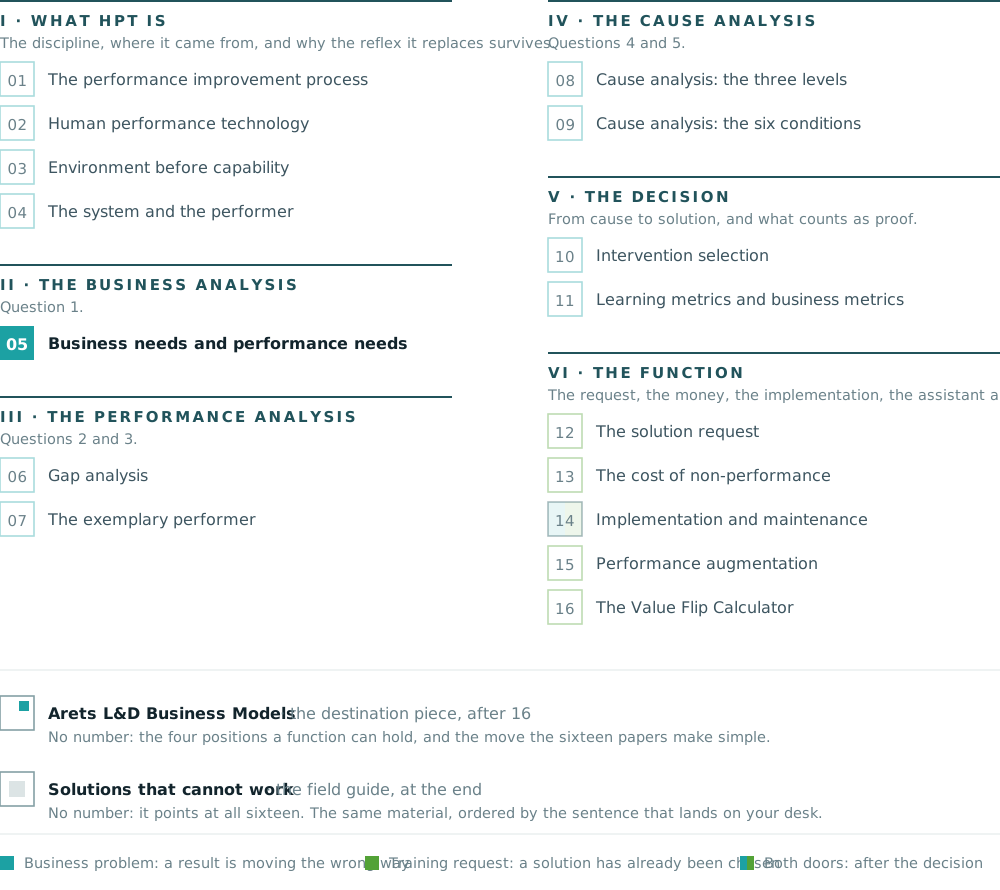
Two further pieces close the set and carry no number, because each points at all the numbered papers. Before the guide sits Arets L&D Business Models, the destination piece for the people who receive the requests: four models a learning function can run, and the route from HR-driven to business-driven. Last sits Solutions that cannot work, the field guide, ordered by the sentence that lands on your desk: seventeen forms a performance problem arrives in, each with an address in one of the numbered papers. Three orders in all: the destination you choose, the question you are on, and the form that landed on your desk.
How this series came about
Human performance technology travels the way a craft does: from hand to hand. Vivian Heijnen and Jos Arets learned the analysis from Dennis Mankin, in San Diego, more than twenty years ago, and have kept in contact with him ever since. Both remain grateful to him: for the rigor of the method as he taught it, and for the leadership he has given performance consulting over a long career.
What followed was twenty years of use. Vivian took the method into organizations in the Netherlands and well beyond them, and what accumulates over that many analyses is largely tacit: the cut nobody thought to make, the question that opens a defensive room, the finding that turns out to be an artifact of the data. Making that knowledge explicit, case by case, is what this series is for. Jos wrote it down as it went, in two books and more than forty articles and blog posts, most of them in Dutch, and one seven-part English series, Is AI the bicycle of the mind?, which number 15 grows out of. The books: Liever (g)een training with Boudewijn Overduin, Kostbaar misverstand with Vivian Heijnen, which this series takes a good deal of its thinking from.
None of that is reprinted here. It has been reworked: brought up to date, tested against the research that has appeared since, and dropped where the evidence no longer carries it. Theory that has never met a client is a position; practice that cannot account for itself is a story. This series is what remains when each is held to the other. Performance Consultant AI carries the same discipline to the desk where the decision is actually made.
About the cases. Every worked case in this series comes from our own practice. Names are changed and details altered so that no organization is recognizable, and the arithmetic reconciles. That is said once, here, rather than under each case: client work is confidential, and a case that named anybody would be a breach rather than a proof.
Tulser · White Papers · Performance Consulting
The series
Sixteen papers, six parts
Number 01 is the map and number 02 is the foundation. From number 05 on, every number is depth on exactly one step of the method. The filled block is the paper you are holding; the two unnumbered pieces close the set.
Tulser · White Papers · Performance Consulting
References
Where every claim in this paper comes from
Albarracín, D., Fayaz-Farkhad, B., & Granados Samayoa, J. A. (2024). Determinants of behaviour and their efficacy as targets of behavioural change interventions. Nature Reviews Psychology, 3(6), 377–392. https://doi.org/10.1038/s44159-024-00305-0
Garavan, T. N., McCarthy, A., Lai, Y., Clarke, N., Carbery, R., Gubbins, C., Sheehan, M., & Saunders, M. N. K. (2021). Putting the system back into training and firm performance research: A review and research agenda. Human Resource Management Journal, 31(4), 870–903. https://doi.org/10.1111/1748-8583.12337
Blume, B. D., Ford, J. K., Baldwin, T. T., & Huang, J. L. (2010). Transfer of training: A meta-analytic review. Journal of Management, 36(4), 1065–1105. https://doi.org/10.1177/0149206309352880
Deming, W. E. (2000). Out of the crisis (2nd ed.). The MIT Press. (Original work published 1986)
Gilbert, T. F. (1978). Human competence: Engineering worthy performance. McGraw-Hill.
Hughes, A. M., Zajac, S., Woods, A. L., & Salas, E. (2020). The role of work environment in training sustainment: A meta-analysis. Human Factors, 62(1), 166–183. https://doi.org/10.1177/0018720819845988
Harless, J. H. (1985). Performance technology and other popular myths. Performance & Instruction, 24(9), 4–6.
Kang, S., & Molenda, M. (2018). Judging the quality of instructional design and performance improvement. Performance Improvement Quarterly, 31(2), 189–212. https://doi.org/10.1002/piq.21276
Mager, R. F., & Pipe, P. (1997). Analyzing performance problems, or you really oughta wanna (3rd ed.). Center for Effective Performance.
Kaufman, R., & Guerra-López, I. (2013). Needs assessment for organizational success. ASTD Press.
Robinson, D. G., & Robinson, J. C. (2008). Performance consulting: A practical guide for HR and learning professionals (2nd ed.). Berrett-Koehler.
Rummler, G. A., & Brache, A. P. (2013). Improving performance: How to manage the white space on the organization chart (3rd ed.). Jossey-Bass. (Original work published 1990)
The three books named earlier in this paper are listed in full in number 02, so that they do not recur in every reference list.
Tulser · White Papers · Performance Consulting